

Most shopping advice treats light olive oil as the sensible, lighter choice and extra virgin as the indulgence. That framing fails as soon as both bottles are on the counter. One is an unrefined oil you can taste. The other is a refined oil built to stay quiet. If you're choosing between them for dinner, the useful question isn't which one saves calories. It's which one belongs in the bowl, the pan, or the cake.
You'll be able to match each oil to a dish, ignore calorie marketing, and read a label for flavor and processing rather than a health slogan.
Table of Contents
- Why Extra Virgin and Light Olive Oil Differ
- How Extra Virgin and Light Olive Oil Are Made
- Flavor Chemistry and Heat Side by Side
- Best Uses for Extra Virgin and Light Olive Oil
- How to Buy Olive Oil Without the Light Trap
- Which Olive Oil to Choose for Each Kitchen Job
- A Practical Next Step for Your Pantry
Why Extra Virgin and Light Olive Oil Differ
“Light” olive oil can carry the same calories as extra virgin. The label points to a milder flavor and a different level of processing, not a lower-fat product. That distinction helps explain why one bottle adds character to a dish while another stays in the background.
Both are full-fat oils, with about 9 calories per gram, or roughly 120 calories per tablespoon. The UC Davis guide to olive oil myths and facts explains why terms such as light, pure, and cold pressed can confuse shoppers. In one global consumer survey, 26% of respondents expressed doubts about what those terms mean. Earlier consumer research found that, among surveyed consumers, 64% associated extra-light olive oil with lower fat and 62% associated it with fewer calories.
Flavor and processing, not a diet claim
Label check: Light describes a milder flavor and how the oil was processed, not a lighter fat.
The names can steer a cook toward the wrong bottle. Choose extra virgin when you want the oil's own flavor to come through, such as in a dressing. Choose light when you want olive oil's cooking function with less flavor competing with the other ingredients, such as in a cake.
Extra virgin olive oil is unrefined and fruit-forward. Light olive oil is typically refined, and may be blended with a small amount of virgin oil to add some flavor. Neither is a diet product. Check the grade and processing details on the back label, then match the bottle to the dish.
How Extra Virgin and Light Olive Oil Are Made
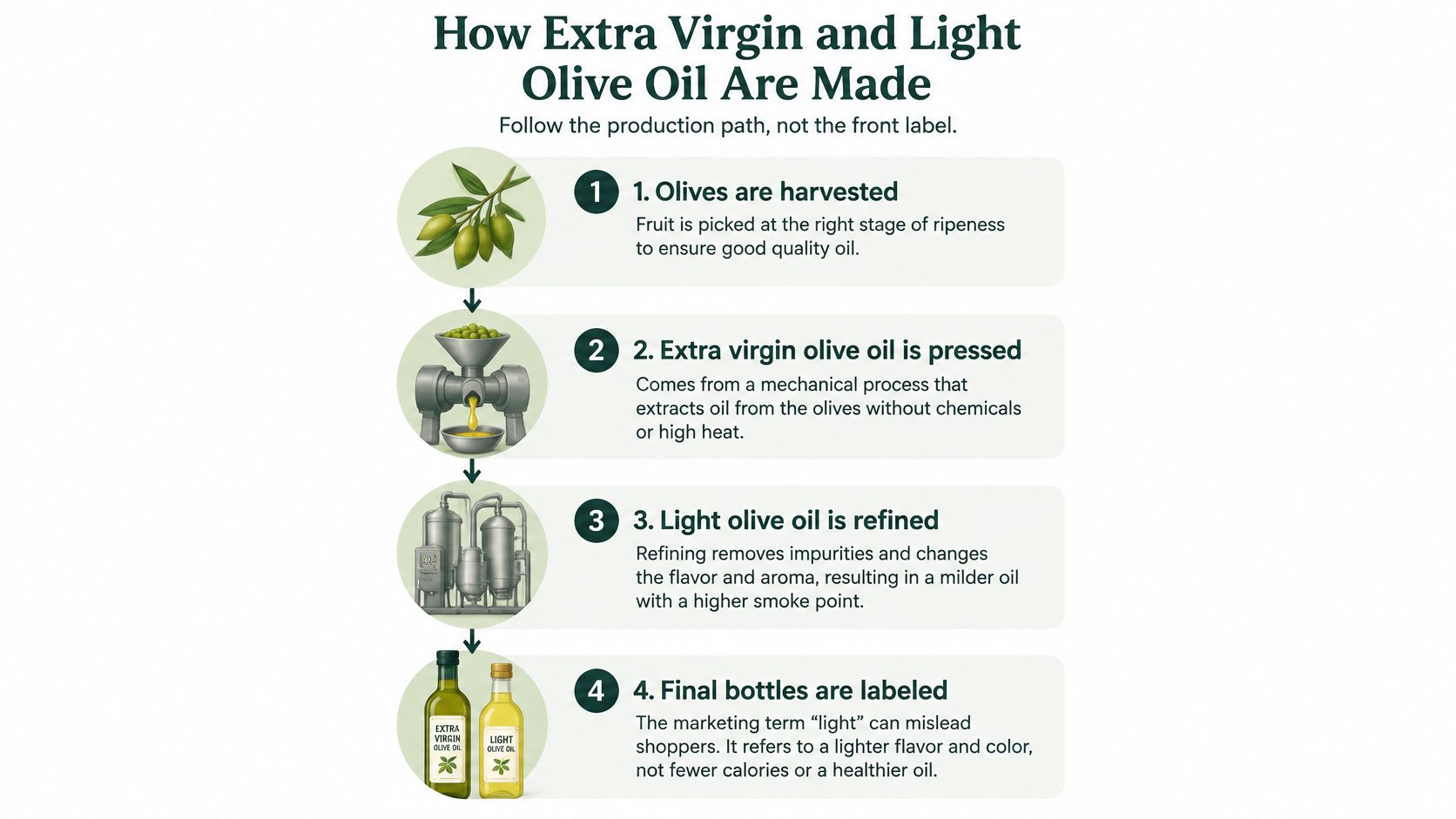
The quieter bottle has been processed more, not made from a different kind of fat. That distinction starts with how each oil is produced.
Extra virgin olive oil is extracted from olives and sold without refining. To qualify, it must meet chemical and sensory standards, including a fruity character and no sensory defects. The International Olive Council's trade standard sets these free-acidity limits:
| Grade | Maximum free acidity |
|---|---|
| Extra virgin olive oil | 0.8 grams per 100 grams |
| Refined olive oil | 0.3 grams per 100 grams |
The refined path behind a light label
Refining starts with virgin olive oil that needs treatment to meet the refined grade. Processes such as decolorization and deodorization reduce pigments and strong aromas, producing a milder base. The oil's glycerides, the molecules that make up its main fat structure, remain olive oil.
Bottled light olive oil commonly combines this refined base with some virgin olive oil. That blend adds a little olive character; the amount helps determine how mild the finished oil tastes. “Light” describes that flavor, not a lower-calorie grade.
What refining keeps and what it thins
Refining changes more than aroma. It can reduce some minor compounds, including phenolic compounds and tocopherols, while leaving the oil's main fats in place. Extra virgin oil generally retains more of these minor compounds because it is not refined.
At the counter, the production difference is practical: extra virgin carries more of the olive's original flavor, while refined oil offers a quieter base. A small amount of virgin oil can give that base a hint of fruitiness without turning it into an extra virgin oil.
Flavor Chemistry and Heat Side by Side
Line the bottles up by what you can taste and what the pan does to that taste. This isn't another trip through the mill. It's the outcome in a spoon.
Extra virgin vs light olive oil at a glance
| Criterion | Extra virgin olive oil | Light olive oil |
|---|---|---|
| Production status | Unrefined, fit to consume without refining | Refined, often blended with some extra virgin for a milder taste |
| Free-acidity ceiling | No more than 0.8 grams per 100 grams | Refined oil capped at 0.3 grams per 100 grams |
| Sensory requirement | Zero median defects and positive fruitiness | Refined base is flavorless and odorless |
| Flavor in the bottle | Fruity, often bitter or peppery | Mild to neutral, set by the blend |
| What processing changes | Volatile and minor compounds stay | Strong aroma is refined away, glyceride structure remains |
| Cooking role | Choose it when fruitiness is part of the dish | Choose it when a neutral olive-oil character is preferred |
Those acidity and sensory lines follow the International Olive Council trade standard. In that same practical reading, light is the amount of extra virgin blended into refined oil. It isn't a lower-calorie slot.
Light is milder flavor, not lighter fat.
A clean extra virgin can taste green, bitter, or hot at the back of the throat. That pepper is part of a positive profile, not a flaw you should shop around. A light oil is built not to announce itself. It disappears into mayonnaise, a plain cake, or a large sauté of onions, where you want olive oil's fat and not a second ingredient arguing with the garlic.
Heat without a made-up smoke point
No single smoke-point number belongs here. Freshness, grade, and the pan all move the moment an oil smokes, and a label that only says light doesn't hand you a temperature. The useful split is about character. Choose light olive oil when you want a neutral olive-oil character for a long cook. Choose extra virgin when fruitiness is part of the dish, and accept that high heat and long simmering mute the aromas you paid for.
When the oil meets a strong partner, the extra virgin is the one with something to say. A chocolate and olive oil pairing shows that this bottle can finish a dessert as well as a salad. A refined light oil would mostly add fat and very little aroma.
Best Uses for Extra Virgin and Light Olive Oil
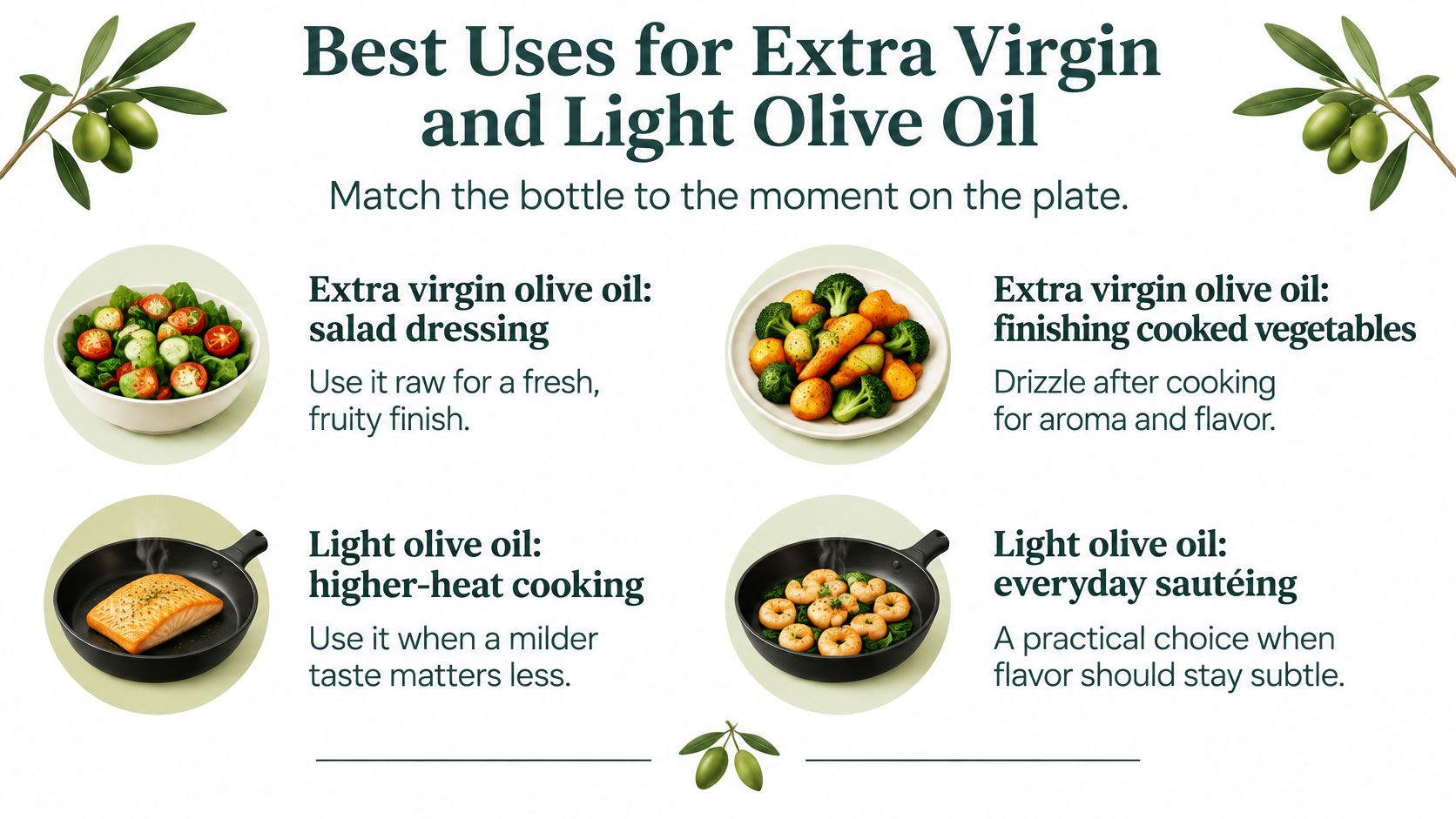
The right bottle depends on the job: extra virgin contributes flavor, while light olive oil is processed for a milder taste. Both are oils, so “light” does not mean lower in calories. At the counter, ask whether olive flavor belongs in the finished dish.
When the oil is the seasoning
Extra virgin works well where fruitiness, bitterness, or pepper can shape the dish: a green salad with lemon and salt, tomatoes with herbs, warm white beans, or vegetables finished after grilling. It can also carry flavor through a poaching liquid. In olive oil-poached cod, the oil surrounds mild fish, bringing its own character to each bite.
When you want the fat and not the speech
Refining removes much of olive oil's distinctive flavor, so light olive oil suits dishes where a strong olive note would compete. It still provides fat, not a diet shortcut.
- Mayonnaise and other emulsions: A mild oil leaves the egg, acid, and salt in the foreground. A peppery extra virgin can make the result taste sharper.
- Plain cakes and muffins: Use light olive oil when you want a tender crumb without a pronounced olive taste.
- A sautéed soup base: Light olive oil lets onions soften without making their flavor compete with the oil.
Finishes that are still extra virgin
Some dishes call for a flavored extra virgin as a finishing touch. Add it off the heat, where its aroma can stand out.
Mantova Sicilian Lemon Extra Virgin Olive Oil Spray, 8 oz combines extra virgin olive oil with Sicilian lemon essential oil in a propellant-free spray. A light coating over fish, burrata, or pasta adds lemon fragrance and gloss. It does not replace lemon juice when a recipe needs acidity.
Il Boschetto Truffle Infused Extra Virgin Olive Oil is a Tuscan extra virgin oil infused with summer truffle. Add a few drops over eggs, risotto, or mushrooms, and keep it off the heat.
Choose light olive oil when the recipe needs a mild cooking fat. Choose extra virgin when the oil's own flavor belongs in the dish.
How to Buy Olive Oil Without the Light Trap
Buying is a different job from cooking. Read in a fixed order, then shop.
A three-step label order
- Reject the calorie hint. If light is being sold as less fat, put the bottle back. That word is about flavor.
- Decide fruit or neutrality. Pepper and fruit mean extra virgin. A quiet fat for mayonnaise or baking means a mild refined oil, and that oil shouldn't be dressed up as a lower-fat extra virgin.
- Read the grade, not the slogan. Extra virgin means unrefined oil that passed a sensory bar. A light style is refined oil blended for mild flavor.
Signals that follow from the grade
You don't need a lab score to avoid a tired bottle.
- Smell for fruit: A fresh extra virgin should smell alive, not like crayons or stale nuts.
- Store it dark and cool: A cupboard away from the stove protects flavor better than a sunny counter.
- Finish flavorful oil while it still tastes alive: Intensity fades. A huge tin isn't a bargain if the last half tastes flat.
A dark, cool cupboard beats a pretty bottle parked next to the stove.
Drop of Life™ Grand Reserve First Harvest Olive Oil is one concrete version of the fruit-forward path. It's a first-harvest extra virgin from Arcadia, Greece, pressed from green olives, bitter and peppery, and meant for warm bread, white beans, grilled fish, or a tomato. Taste it on bread first. Cooking it away wastes the reason it was pressed early.
Lello.Store is one U.S. shop that follows that order. It's a curated pantry of extra virgin oils from named regions and small makers, plus infused oils for finishing, with guides that explain use rather than diet claims, an Under $25 path for everyday staples, and human support by phone and email. If you want pepper, shop the extra virgin edit. If you want quiet fat for mayo, don't hunt for it inside a "lighter" extra virgin.
The guide to choosing extra virgin olive oil walks the same order when the label still feels crowded. A short look at how grades differ is worth it before you restock, so the front label isn't doing the thinking.
Which Olive Oil to Choose for Each Kitchen Job
Choose extra virgin when the oil is a flavor, and light or refined olive oil when the oil is a neutral fat with an olive origin.
Jobs you can cook tonight
Weeknight onions and garlic. A mild light oil keeps the sauce quiet. You're sweating a base for tomatoes or beans, and a loud peppery oil will sit on top of the garlic instead of under it.
A vinaigrette or a tomato salad. Extra virgin is the seasoning. Acid, salt, and that fruity fat are the dressing. A flavorless refined oil leaves the bowl tasting like lemon water on vegetables.
The next two jobs flip the priority from aroma to restraint.
- Cake batter or mayonnaise: A strong peppery oil dominates a butter-free cake and turns mayo harsh. Light or refined olive oil keeps the crumb, or the emulsion, in the background.
- Seafood or a cheese board, off the heat: A fragrant extra virgin earns the plate. That includes a lemon finish or a few drops of truffle oil used only at the table. If a spray is the tool you're considering, this olive oil spray guide covers the nozzle's purpose.
The limit on both bottles
Refined oil isn't worthless. It still supplies monounsaturated fat, which is why it works as a cooking fat when aroma isn't the point. Extra virgin isn't automatically the right pan oil when its aroma will be cooked away. Paying for fruit and then frying it out is just the expensive version of the wrong bottle.
If you can't taste the oil, don't pay for fruitiness. If you can, don't hide it in a refined blend.
A Practical Next Step for Your Pantry
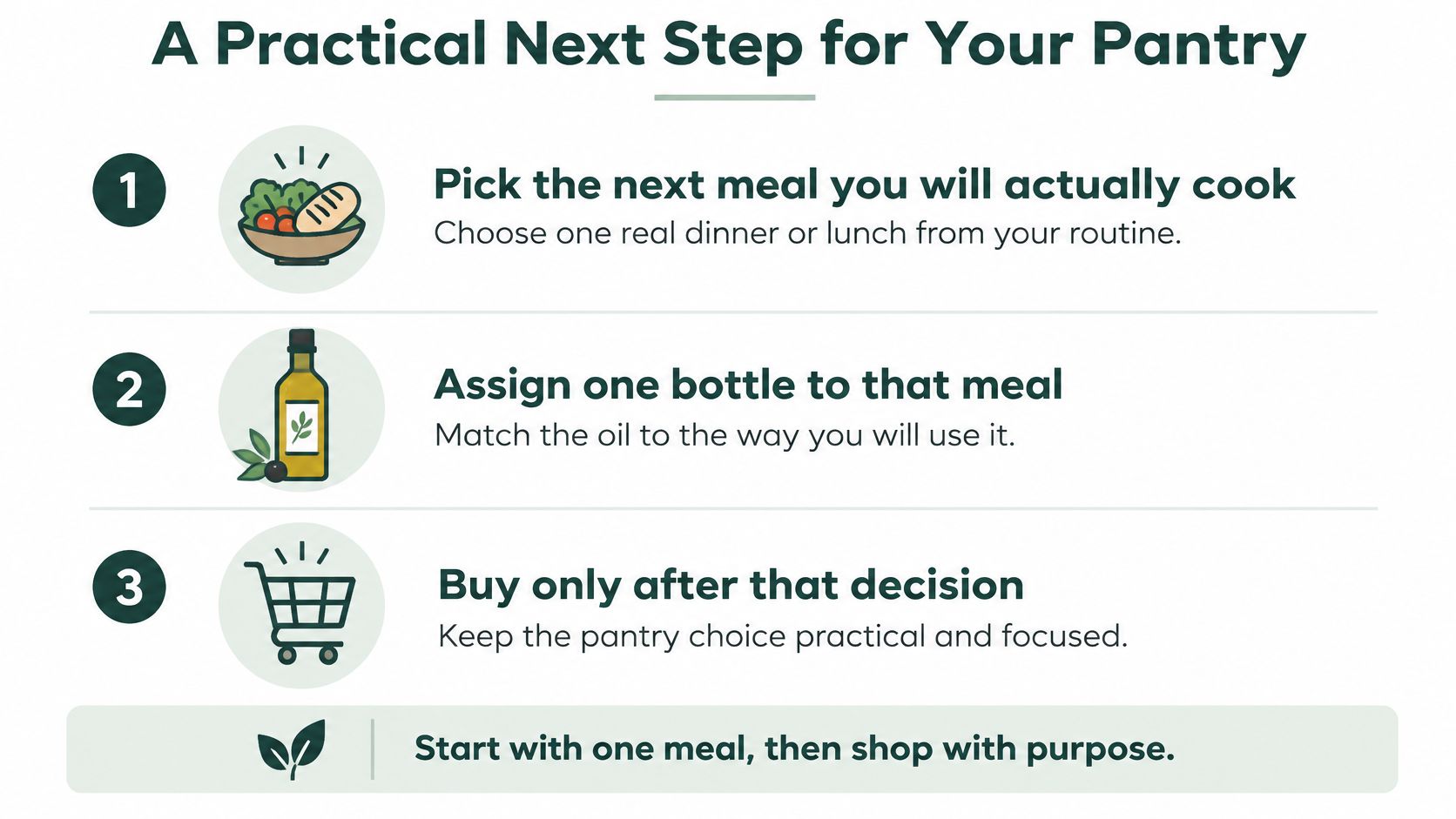
Pick the next meal you will really cook, and assign one bottle to it before you buy anything else.
A salad, grilled fish, or a pasta finish gets extra virgin. Mayonnaise, a plain cake, or a large mild sauté gets light or refined olive oil if neutrality is the goal. That assignment is the shopping list. You don't need a third bottle to feel prepared.
Keep both only if both jobs are real
Two bottles make sense when your week really does include a raw finish and a neutral cook. They don't make sense as a matched set for show. Extra virgin wasted as an all-purpose fry oil loses the fruit you bought. Light oil drizzled where fruit was the point tastes like the seasoning never showed up.
If the plate needs aroma, look for an unrefined extra virgin or a finishing oil such as a lemon spray or a truffle oil. Use a shop's guides when the question is how to use the bottle, not whether light means diet. Gift and hosting edits exist for someone buying oil as part of a table rather than a single sauté. That's a different errand from Tuesday's onions, and it shouldn't push you toward a flavorless refined oil.
Freshness still decides whether the extra virgin is worth opening. If you're unsure how long a bottle stays lively, start with whether olive oil expires before you stock two large tins. Then reach for the single bottle that meal needs.
Lello.Store curates extra virgin olive oils, infused finishing oils, and practical guides that sort bottles by how you'll cook, not by diet slogans. If you're ready to match an unrefined, fruit-forward oil or a quiet cooking oil to a real dish, visit Lello.Store and choose the bottle for the meal you'll make next.