

The most repeated tip for balsamic glaze truffle is to drizzle it on everything savory and call the plate finished. That advice skips the part that changes the food. A sweet-tart, spoon-coating condiment is a formulated sauce. Its label, how far you reduce it, and how much heat it sees matter more than a generic pairing list.
A louder truffle smell isn't automatic proof of more truffle. Thickness and sweetness aren't proof that the vinegar was aged for years. If you're hosting, the useful skill is narrower. Reduce the balsamic until it coats without tasting like burnt sugar, add truffle late enough that the aroma survives, and decide whether the jar belongs on a cheese board, a steak, or only as a tiny cocktail garnish.
Table of Contents
- What Balsamic Glaze Truffle Is
- How to Tell Real Truffle from Flavoring
- Reducing Balsamic Before the Truffle Goes In
- Keeping Truffle Aroma Through Service
- Finishing Plates and Cocktails with the Glaze
- Storage Sweetness and When Not to Cook It
- Build a Small Truffle Pantry at Lello
What Balsamic Glaze Truffle Is
Balsamic glaze truffle is a finishing sauce, not a protected aged vinegar. The name usually describes a sweet-tart condiment with a truffle aroma, while Traditional Balsamic Vinegar of Modena P.D.O. is made under a separate set of rules. Knowing which bottle you have helps you control sweetness and acidity before it reaches the plate.
According to the consortium's frequently asked questions, traditional balsamic has a documented production history in Modena dating back at least to the 11th century. The protected vinegar must be made in the province of Modena from cooked grape must, then fermented and aged in wooden casks. Affinato requires at least 12 years and Extravecchio at least 25 years, under the rules set out in the consortium's frequently asked questions. A thick pour or sweet taste does not establish either designation. Traditional bottles use a standardized 100-milliliter format, so this is a small finishing vinegar, not a bottle to pour freely into a pan.
Why commercial glaze is a different bottle
Commercial glaze is built from vinegar, must, sugar, or starch, a composition covered in detail in section 6. For the cook, the key distinction is practical: the texture of a glaze can come from its formulation, while the age designations apply to protected vinegar made under specific rules.
A dark, syrupy appearance can make the two seem interchangeable. They are not. Texture is easy to create with ingredients such as grape must, sugar, and starch; age depends on production and qualification. Read the designation before the serving suggestion. “Glaze” identifies a sauce, while “Traditional” and its age category identify a protected vinegar.
If you want a lighter option for salads or fruit, choose a separate bottle rather than asking a dark glaze to do both jobs. This guide to golden balsamic vinegar compares that style with darker balsamic.
In a truffle glaze, the balsamic provides acidity, sweetness, and body. Truffle contributes aroma, which heat can quickly diminish. Keeping those roles distinct makes it easier to balance the sauce and decide when to add it.
How to Tell Real Truffle from Flavoring
A dark truffle picture tells you little about what is inside the jar. Read the ingredient list and the truffle wording first. For a finishing glaze, the label matters because aroma, sweetness, and thickness can come from different ingredients.
Three phrases point to different things. Truffle means a named fungus is included, and a printed percentage indicates its share of the product. Truffle aroma signals that an aromatic has been added, which can smell strong even when the fungus is present in a small amount. Natural flavor or artificial flavor, without a species name, gives the least detail. A forceful truffle scent does not prove a high truffle content. Smell a jar of truffle oil beside plain olive oil. A subtle, earthy note with a lingering finish is more likely to come from the fungus than a sharp, synthetic burst.
The label deserves a close read. An independent analysis of commercial truffle foods found that only 20% of 51 products were accurately labeled, 48% had high levels of added flavoring, and some did not match the species named or implied on their labels, according to this labeling study of truffle products.
Supply is small, so the wording matters
Tuber melanosporum, the black truffle used in many condiments, was first cultivated in France in the 19th century. An academic review reports average European production of about 58 metric tons a year from 2003 to 2012, with substantial harvest-to-harvest variation, in this review of truffle cultivation. That limited supply helps explain why truffle often appears as a garnish or concentrated ingredient rather than a bulk component. Its prestige in Italian and French courts during the Renaissance does not change the practical limits: host trees, soil, climate, and season shape the harvest.
Which truffle format to reach for
| Format | Best job | Truffle clue | How much |
|---|---|---|---|
| Homemade reduction | Sweet-tart ribbon you control | Add truffle after cooling | Spoon-coating line |
| Bought glaze | Ready gloss for a board or plate | Check for truffle, aroma, or flavor in the ingredients | Drops, not a pool |
| Truffle mustard | Body and bite in a sauce or sandwich | Named species and printed percentage | Teaspoon |
| Truffle oil | Aroma at the table | Compare oil, truffle, and flavoring in the ingredients | A few drops, never heated |
Use the ingredient list to understand what a product contributes, not just what its name promises. As an example of reading a mustard label, L'Épicurien Périgord Truffle Mustard lists 1.2% Périgord black winter truffle, Tuber melanosporum, in a 7.05-ounce jar from Le Bosc. A teaspoon can season cream sauces, potatoes, or sandwiches. Read the Il Boschetto label and you will find 97% extra virgin olive oil, 2% summer truffle (Tuber aestivum), and 1% flavoring. Use the oil in drops on warm food, without heating it. These formats can complement a glaze, but they do not tell you how sweet, acidic, or thick the glaze itself is.
For a comparison of white-truffle oils, this guide to olive oil with white truffle applies the same label-reading approach, treating “truffle” as an ingredient description rather than a quality grade.
Reducing Balsamic Before the Truffle Goes In
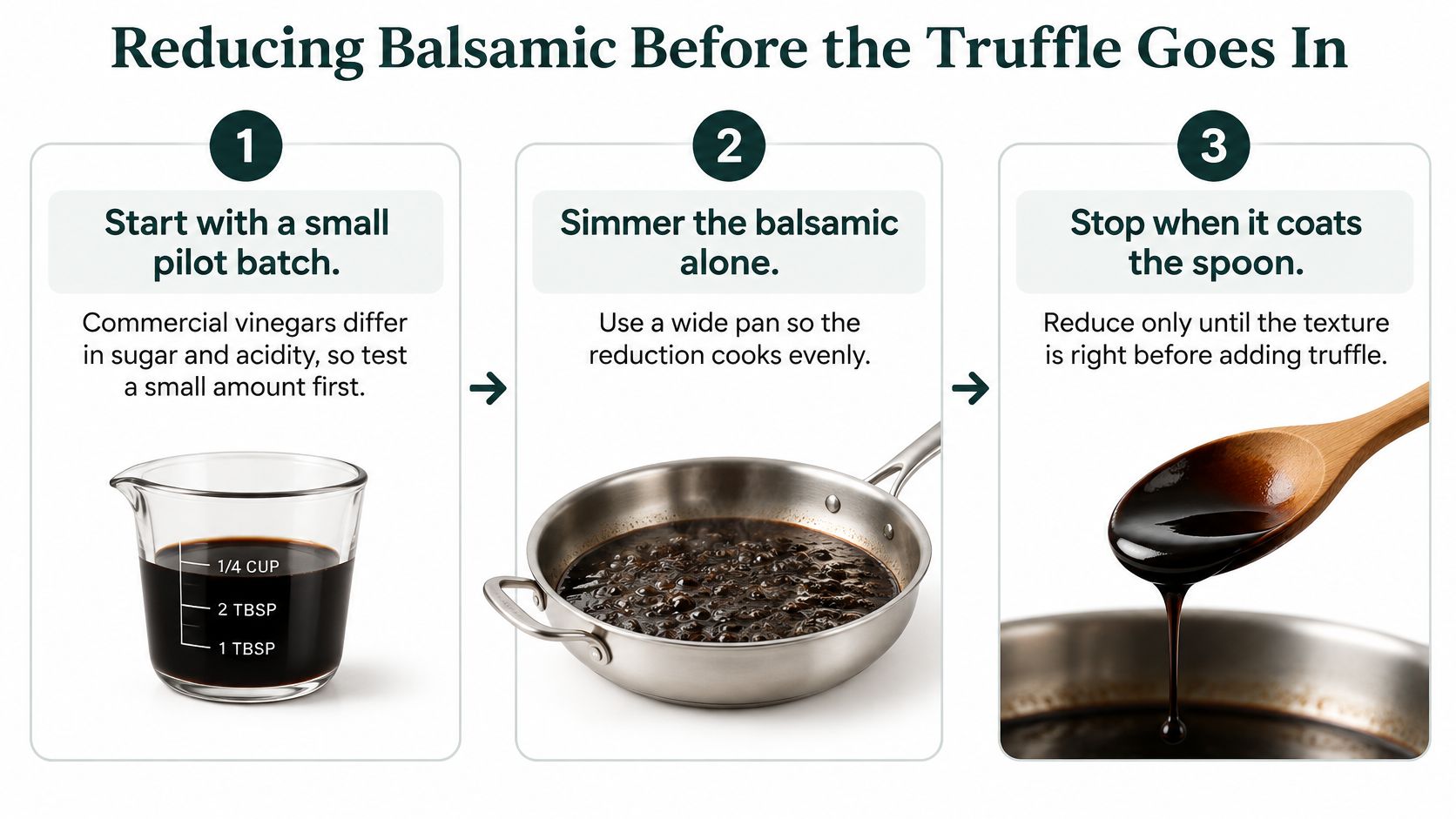
A good balsamic glaze truffle is a formulated finishing sauce, not just a pairing of two ingredients. The vinegar's sweetness and acidity, the reduction's final texture, and when the truffle goes in all shape the result. Since vinegars vary, a timer alone is a poor guide. Start with a small pilot batch and adjust by texture.
Simmer the balsamic by itself in a wide, nonreactive pan. For an initial trial, reduce it until the volume has fallen by roughly 30–50%, then judge the cooled result rather than treating that range as a rule for every bottle. A wide pan helps water evaporate across the surface. Stir and watch the edges, where sugars can scorch while the middle remains thin.
Stop when the cooled glaze coats a spoon in a continuous film and pours in a slow, unbroken ribbon. If it runs like water, it needs more reduction. If it clings in a sticky mass or tastes of burnt sugar, it has gone too far. As the vinegar concentrates, its sweetness and acidity both become more pronounced.
The FAO record on balsamic rheology discusses density, soluble solids, and melanoidin structure in relation to balsamic vinegar's thickness and flow. That helps explain why two vinegars can behave differently in the same pan. You don't need a lab viscometer. You need an endpoint you can recognize and repeat.
What to write down
- Starting and ending mass: Weigh the pan contents before and after reduction so you can compare batches.
- Reduction yield: Divide the ending mass by the starting mass to record how much the sample reduced.
- Spoon or ribbon result: Note whether the cooled glaze coats the spoon and pours in one ribbon.
- Three scores: Rate sweetness, acidity, and how long the flavor lasts on a simple scale.
Wait until the reduction is no longer actively steaming before adding truffle paste, minced preserved truffle, or truffle-infused fat. Steam is a practical warning that the mixture is still hot. Add the truffle once the base has cooled enough to protect its aroma.
Two reductions, not one formula
If the vinegar has enough natural sweetness, keep the reduction plain: cook until the ribbon forms, cool it, then add truffle. If the bottle is already dense, stop sooner and leave the sauce looser. Honey or starch can add body, but they are optional. Either changes sweetness and how firmly the glaze sets as it cools.
Le Marké Organic Balsamic Vinegar of Modena I.G.P. is a practical pilot bottle. It is organic and from Modena, with a dense texture and balanced sweet-sour flavor. Under the I.G.P. rules, Balsamic Vinegar of Modena I.G.P. is made in Modena or Reggio Emilia from cooked grape must and wine vinegar, then aged in wood for at least sixty days. It is an everyday category, not a cellar reserve, so a small test reduction is a sensible way to learn how it behaves. This guide to Italian balsamic vinegar styles can help compare bottles before choosing one to reduce.
Match next week's batch to this week's ribbon, not to a timer. Sugar and acid vary by brand and sometimes by lot.
Keeping Truffle Aroma Through Service
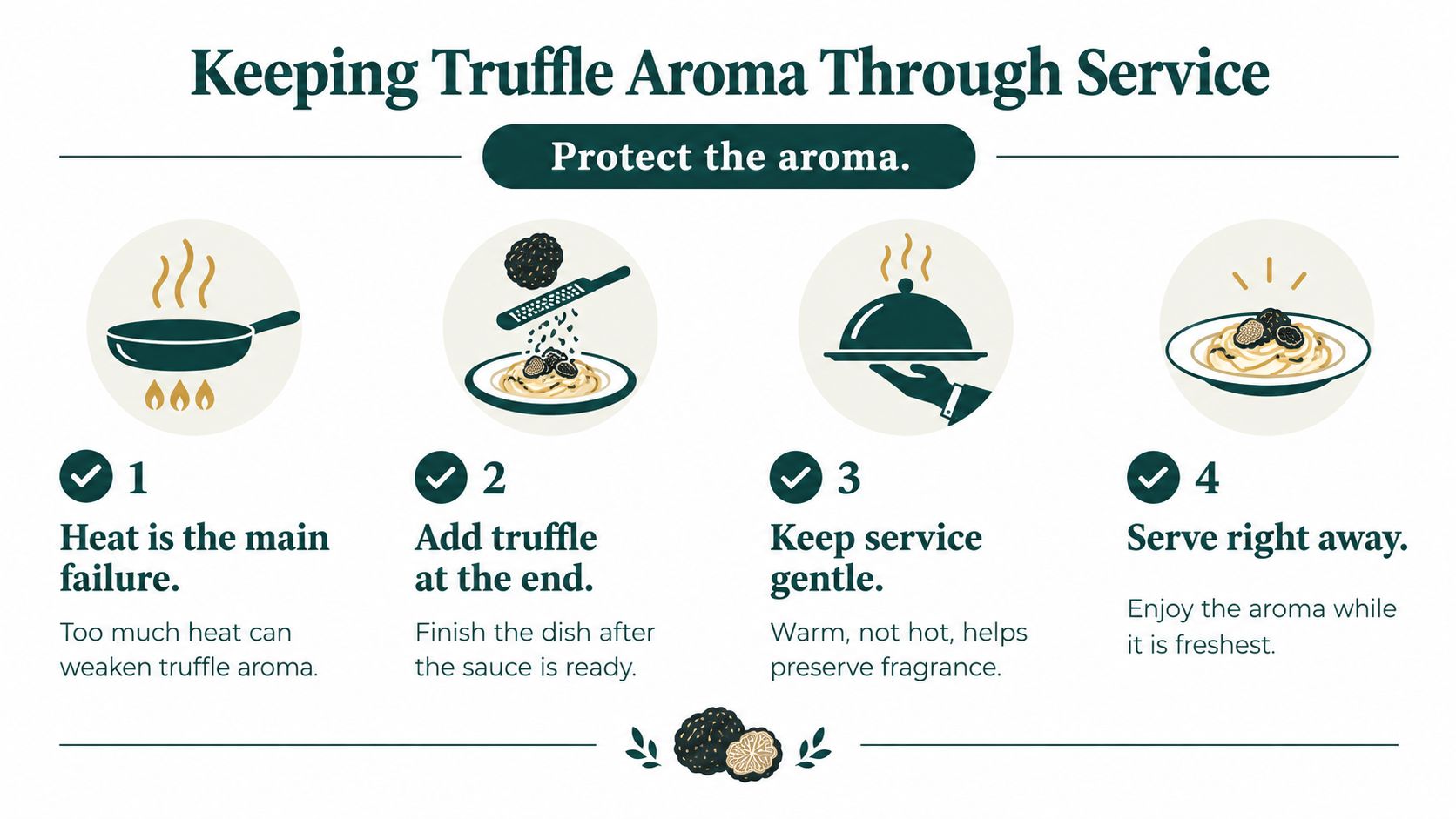
A glaze can have the right thickness and still lose its truffle character. Heat, not a perfect ribbon, is the main risk during service.
Research on homemade truffle products detected more than 80 volatile compounds, and a study of truffle product volatiles found that pasteurization and sterilization could reduce or eliminate important truffle aroma. The effect also depended on the food around the truffle. A sticky, acidic glaze does not shield these compounds from heat, so the aroma can fade even when the sauce tastes rich.
A service sequence that keeps the smell
Let the reduction cool until warm, with no visible steam. Add the truffle and give it a brief rest so its aroma can spread. Keep the mixture away from a second boil, prolonged hot holding, and forceful blending, all of which expose the aroma to extra heat or handling.
Taste the glaze at serving temperature. A sample that tastes balanced over a warm steak can read sharp when it sits chilled on a cheese board. Try both temperatures before serving, then adjust the balance if needed.
Three ways the aroma disappears
- Over-reduction: Vinegar becomes so prominent that the truffle stays in the background, even at a measured dose.
- Too much salt: Salt can balance sugar, but excess salt can mask the fungus before acidity has a chance to balance the taste.
- Judging in the first minute: The aroma just after mixing may differ from what guests smell thirty minutes later.
At 5, 30, and 120 minutes, score truffle aroma, acidity, sweetness, viscosity, and finish from 1 to 5. Keep the formula only if the truffle remains clearly perceptible at the interval when guests will eat. That hold-time gives a more useful service test than relying on the phrase “drizzle at the end,” since finishing a dish and serving it may happen at different times.
Finishing Plates and Cocktails with the Glaze
Use the glaze as a line, not a sauce that coats the food. Two plates and one drink are enough to learn the balance.
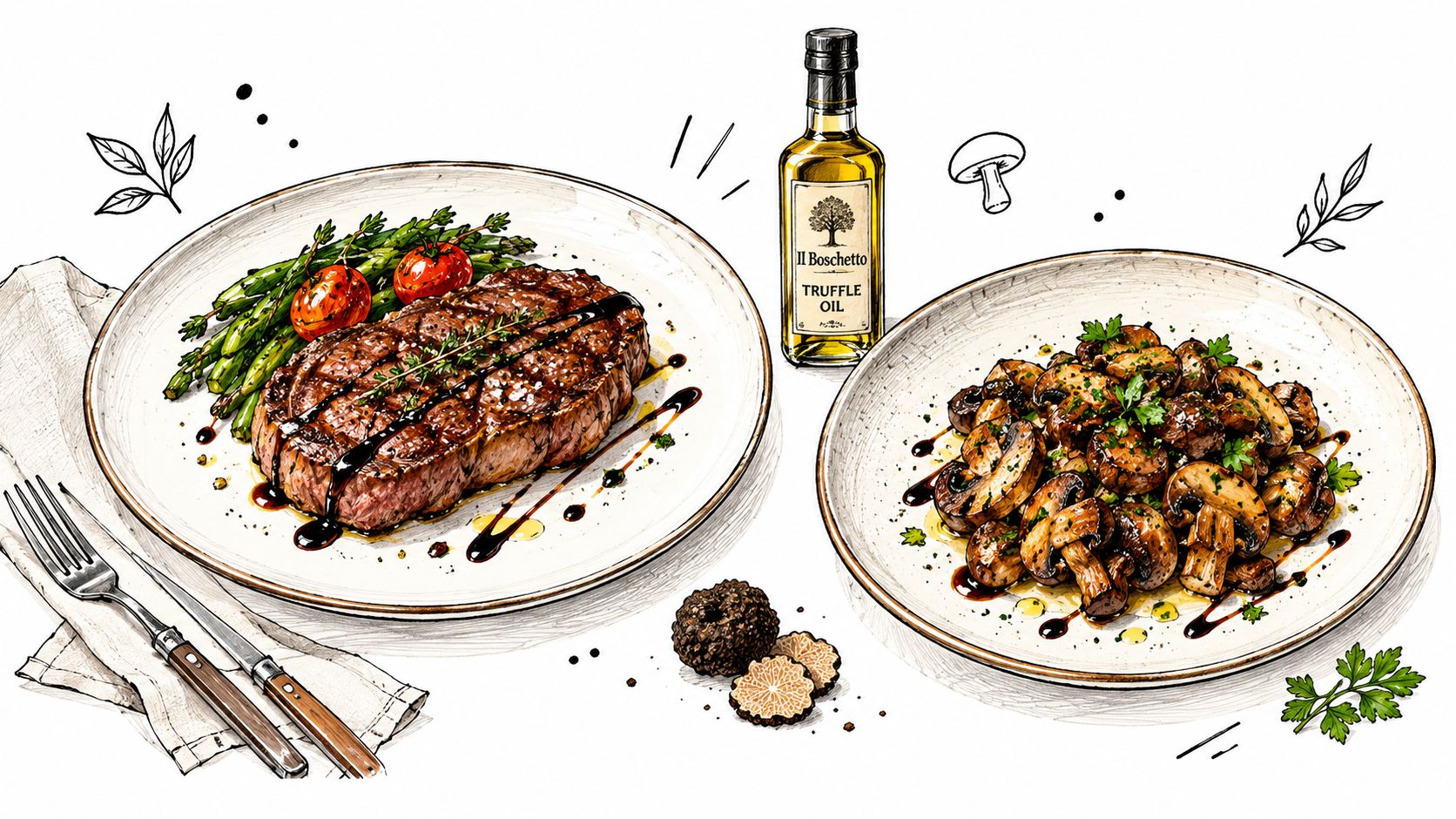
On a weeknight steak or a pan of mushrooms, keep the hot cooking separate from the aroma. Rest the meat, then lay down a thin ribbon of glaze. At the table, add a few drops of Il Boschetto truffle oil. The oil never sees the pan, so the earthy smell stays distinct from the sweet-tart line. Mushrooms already carry a savory base, so you need less glaze than you think. If the plate tastes only sweet, don't add more glaze. Add salt, a little of the meat juices or olive oil, or a brighter splash of unreduced vinegar.
When mustard should carry the earth
A roast-beef sandwich or a creamy pasta is a different problem. Heat in a simmered pan sauce dulls truffle and pushes sweetness forward, which is why the glaze shouldn't be the thing you boil into the cream. Use a teaspoon of L'Épicurien truffle mustard in the sauce or on the bread for the earthy note and body. Keep the glaze as a sweet-tart line on the plate so the two don't compete. Mustard has bite. Glaze has gloss. Asking one jar to do both usually means you taste sugar and miss the fungus.
Cheese and a stirred drink
For cheese, choose an aged wedge and a salty finish so the sugar isn't sitting alone on a mild, creamy surface. A few drops beside Parmigiano do more than a zigzag across the whole board.
For cocktails, treat the glaze as a garnish, not a mixer. A small dot on a citrus peel, a brush on the rim of a stirred drink, or a touch beside maraschino cherries is plenty. A shaken sour is cold, acidic, and foamy. Glaze in the shaker turns the drink sticky and buries any truffle you added. The same restraint shows up in a home aperitivo setup, which this piece on an elegant aperitivo at home treats as a few precise finishes rather than a crowded bar.
If it tastes only sweet, reach for salt, fat, or a brighter acid. More glaze rarely fixes a glaze.
Storage Sweetness and When Not to Cook It
Because glaze may contain added sugar and thickener, its label affects how it behaves on the plate, as covered in the composition section above. A retail-style specification lists cooked grape must, balsamic vinegar, sugar, modified corn starch, and caramel coloring, with a pH range of 2.6–3.2, as described in this study of balsamic glaze composition%20103620.pdf).
What the label changes on the plate
A drizzle can bring more sweetness than you expect, especially on cheese or in a cocktail garnish. To compare how two bottles behave, reduce equal amounts to the same ribbon consistency, then weigh what remains. A glaze with added starch may set faster and thicker than plain vinegar. Heat also dulls truffle aroma and makes sweetness more prominent, so keep the finished sauce out of a simmering pan.
Acidity supports stability, but follow the maker's storage directions. Do not treat two glazes as interchangeable. Check the grape-must share and sweetener on each label before reducing either one.
- Grape-must share: More must generally brings greater natural sweetness and a darker, heavier body.
- Added sugar and thickeners: These create gloss and can make a cold sauce taste stickier than plain vinegar.
- Allergens and serving size: Check the starch source and consider the portion before using the glaze as a free-pouring garnish.
For a homemade truffle batch, refrigerate it after opening and use it while its truffle aroma remains clear. Skip an invented storage deadline; the batch and ingredients matter. Plain balsamic vinegar may have different storage needs from a truffle-finished sauce. This guide to what to refrigerate can help you decide what belongs in the fridge and what can stay capped at room temperature.
Use the glaze cold or just warm. Avoid boiling it or holding it hot for a long time. Treat it as a finishing sauce, not as cooking vinegar.
Build a Small Truffle Pantry at Lello
A useful truffle pantry is small and purposeful: a balsamic glaze to reduce, an oil for finishing, and a mustard for adding body to sauces or sandwiches. Each has a different job, so you can learn what sweetness, acidity, and truffle aroma contribute instead of relying on a generic pairing list.
Lello.Store offers products for that kind of test. Il Boschetto's oil is best kept away from heat; L'Épicurien's Périgord mustard works in teaspoon-sized amounts, so its truffle character does not overwhelm a dish. The Lello Kitchen and The Lello Journal show these makers in everyday plates. For an aperitivo gift, House Service and The Gift Room offer a different route from choosing ingredients for a weeknight meal.
Test aroma without sweetness first: add oil to scrambled eggs or mushroom pasta. For guests, compare a little glaze and mustard on steak or a cheese board. The glaze's reduction endpoint is yours to find; stop when it forms a ribbon rather than cooking until it turns sticky. A single pilot batch gives you a repeatable starting point.
Lello.Store brings together olive oils, vinegars, truffle condiments, and cocktail garnishes from small makers, with practical notes for finishing dishes. Choose one oil and one mustard this week, then test a small reduction to find the consistency you prefer.