

You've got ripe figs on the counter, a bottle of balsamic in the cupboard, and salad greens that need something more interesting than oil and vinegar. Or perhaps there's only fig jam in the fridge. Either way, fig balsamic dressing is within reach, but the version you make should match what you have, not send you shopping halfway through prep.
Table of Contents
- Why Fig Balsamic Dressing Earns a Spot in the Pantry
- Ingredients and Tools You Actually Need
- Building the Emulsion That Won't Fall Apart
- Three Batch Formats You Can Switch Between
- Pairing It With Salads, Boards, and the Rest of the Table
- Storage, Shelf Life, and How to Tell When It's Done
Why Fig Balsamic Dressing Earns a Spot in the Pantry
Pull out the figs and balsamic before reaching for honey. The fruit may already supply all the sweetness you want, especially if you're using preserves rather than fresh fruit. A dressing that tastes pleasantly rounded on a spoon can become cloying over sweet tomatoes or roasted carrots.
That's the useful distinction between a fig vinaigrette you finish and one you forget: the fruit should soften the acidity, not bury it. Leave enough tang to make another mouthful appealing.
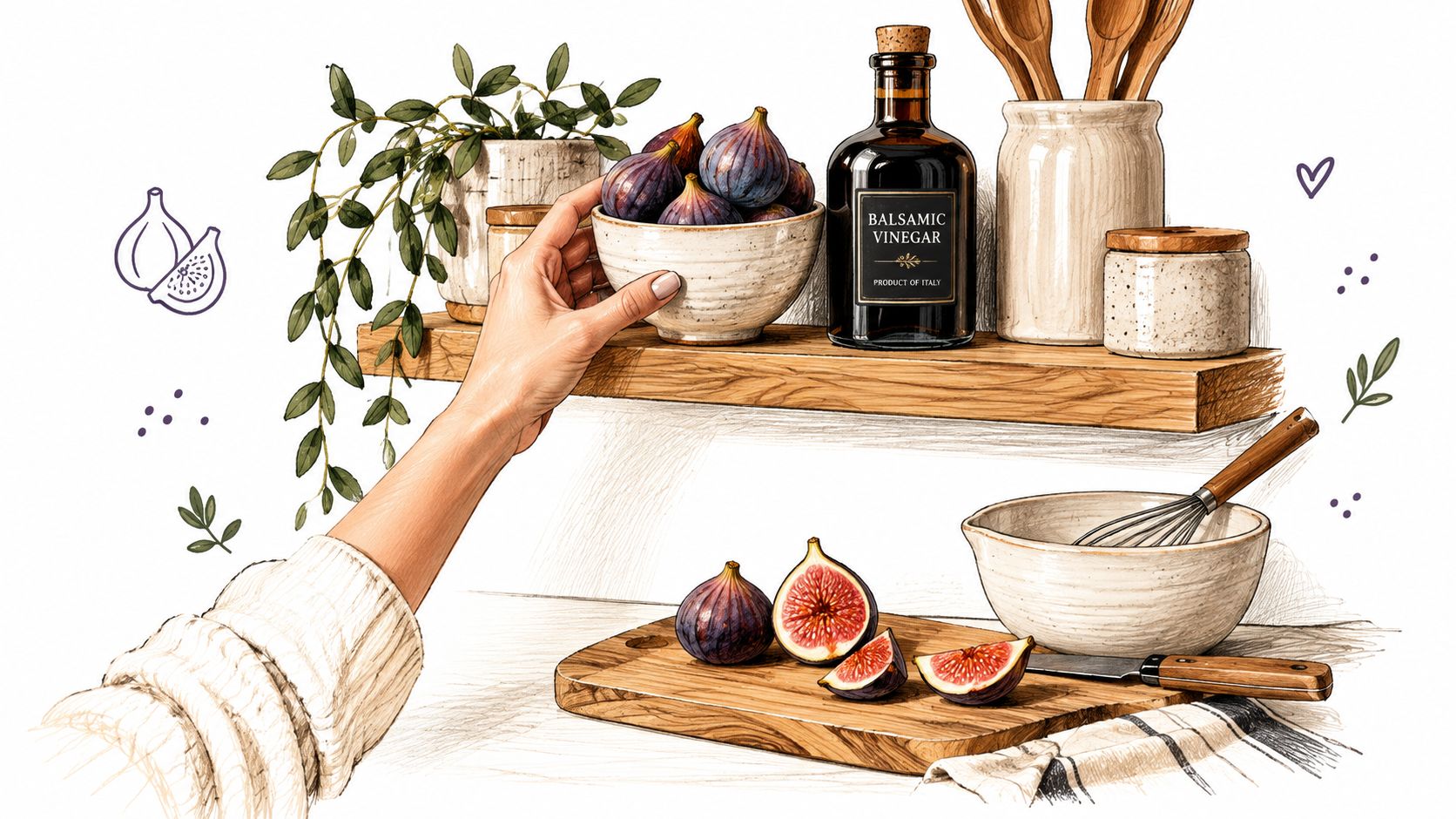
Choose the Ingredients for the Job
Figs are an ancient fruit, while balsamic has a documented regional history in Modena. The protected designation Balsamic Vinegar of Modena PGI identifies a geographic and production framework, not merely a sweet-sour flavor, as explained in the consortium's history of Balsamic Vinegar of Modena.
Provenance helps you understand the bottle, but taste still determines how to use it. For this dressing, I'd choose a vinegar I'm happy to whisk generously, rather than a precious finishing bottle I hesitate to pour. Taste it with the fig ingredient before deciding how much richness to add.
Olive oil matters too. Choose an oil whose flavor you enjoy alongside the fruit; the guide to choosing extra-virgin olive oil is a useful shopping companion.
Think of this as a savory dressing with fruit in it, not a fruit sauce with a little vinegar.
The batch format sets your expectations:
- Fresh fruit suits a cook who wants to use ripe figs and doesn't mind blending.
- Fig jam makes sense when the pantry, rather than the fruit bowl, is supplying dinner.
- Oil-free dressing suits a spoonable sauce, provided you don't confuse removing oil with removing sugar.
That flexibility is why the dressing belongs in your cooking repertoire. It can finish a weeknight salad, accompany cheese, or give leftover roasted vegetables a different direction without requiring an entirely new sauce.
Ingredients and Tools You Actually Need
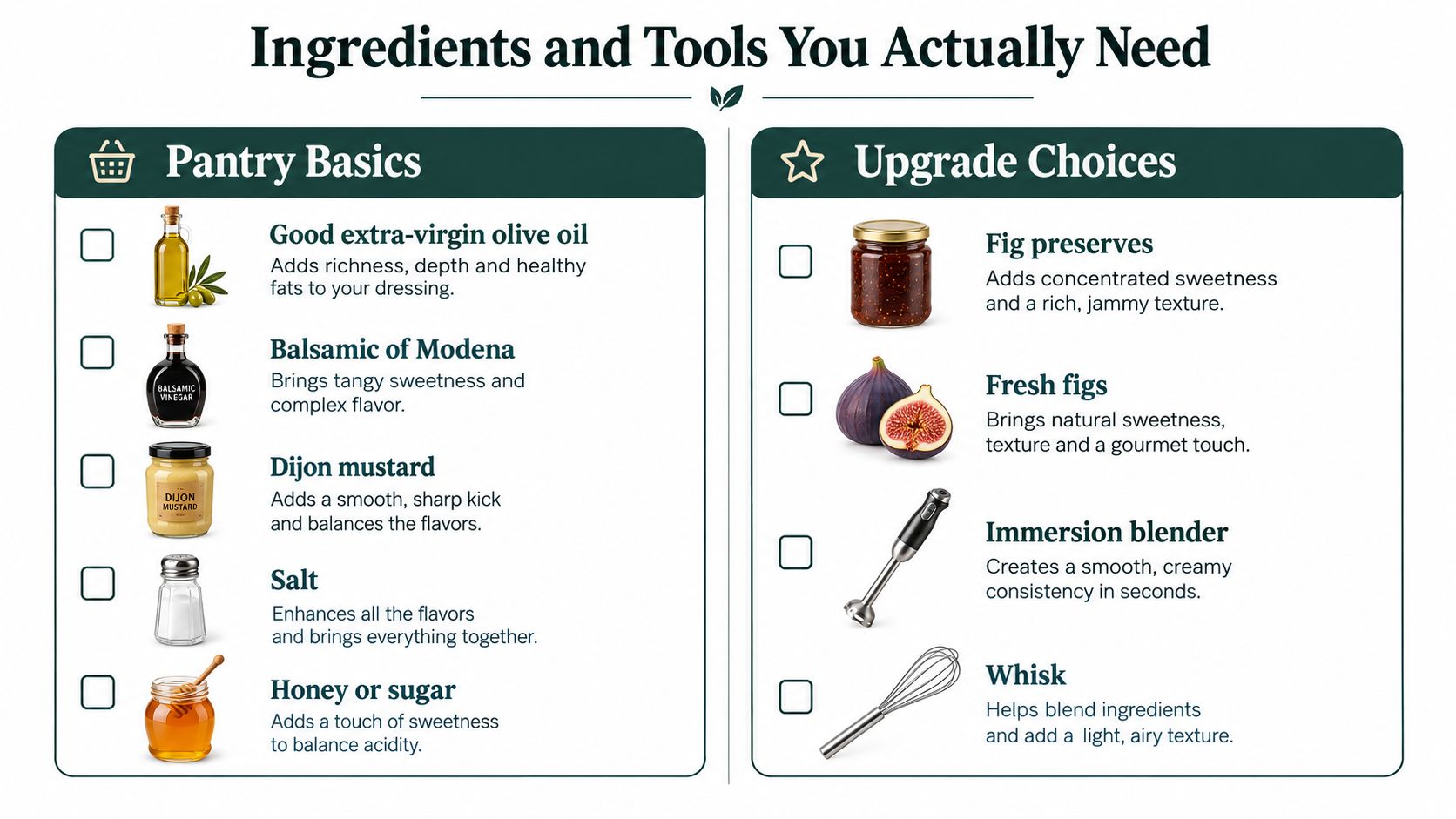
Build the shopping list around balsamic vinegar, your chosen fig ingredient, Dijon mustard, salt, and extra-virgin olive oil for the oil-based formats. Keep water available for adjusting texture. Honey or sugar is optional, not an automatic addition.
The checklist separates essentials from choices you can make according to what's already in the kitchen.
Buy for Flavor, Not Just Thickness
A dense vinegar changes how much fruit and sweetener you'll want. Le Marké Organic Balsamic Vinegar of Modena I.G.P. is an organic option with a dense texture and balanced sweet-sour flavor. With that style, taste the vinegar-and-fig mixture before adding anything sweet.
If you're considering a different vinegar style, the guide to golden balsamic vinegar provides another pantry reference. Treat a substitution as a fresh balancing exercise, not a straight swap you never taste.
Keep the supporting ingredients restrained:
- Dijon mustard belongs in the base mixture, rather than being treated only as a final seasoning.
- Salt should be adjusted after tasting the mustard and vinegar together.
- Honey or sugar should correct a harsh mixture, not compensate for forgetting to taste it.
- Infused oil and finishing salt are optional finishing choices. Establish the plain version before adding competing flavors.
Keep the Equipment Simple
Use a non-reactive bowl and whisk for a smooth jam-based batch. A blender or immersion blender is more useful when you need to disperse fresh fruit. Keep a fine sieve nearby if you want a dressing that pours neatly rather than leaving seeds and fruit pieces behind.
A clean, closable jar makes storage and reshaking straightforward. Choose an opening wide enough to clean properly and a container you can label with the preparation date.
A calibrated pH meter belongs with formulation equipment if you're assessing acidity. It isn't a shortcut to assigning homemade dressing a longer shelf life, and it doesn't replace a validated preservation process.
Building the Emulsion That Won't Fall Apart
The heading describes the goal, not a promise of permanent stability. Oil-based fig balsamic dressing is a temporary oil-in-water emulsion. You're trying to disperse oil finely enough that the dressing stays useful through tossing and serving, not manufacture a permanently uniform condiment.
The process starts with the ingredients that aren't oil.
Make the Base Smooth Before Adding Oil
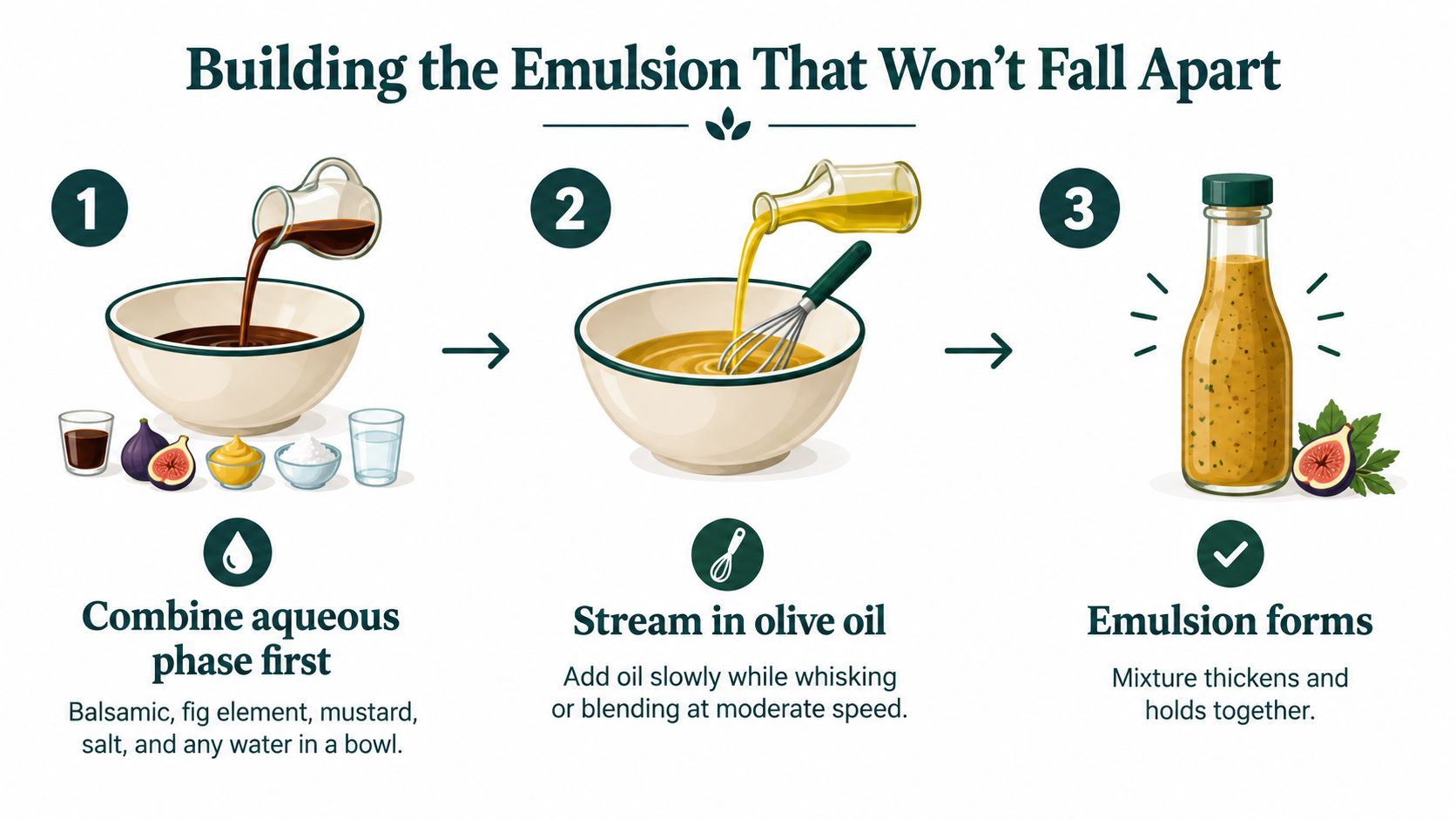
Combine balsamic, fig purée or strained preserves, mustard, salt, and any water. Whisk or blend until the fruit is dispersed and you aren't chasing stubborn pockets of jam around the bowl. If cold preserves resist mixing, loosen them with the liquid ingredients before proceeding.
Then add olive oil in a slow, thin stream, whisking continuously or blending at moderate speed. Look for an evenly mixed dressing with no obvious ribbon of free oil. Stop adding oil periodically and taste it on a leaf, not just from the whisk.
Mustard supplies emulsifying compounds and suspended solids that help limit oil-droplet coalescence. Adding oil too quickly or leaving large fruit particles works against a smooth result; these principles and the bench-testing approach below follow the University of Tasmania's explanation of salad-dressing science.
Compare Ratios Without Assuming the Outcome
For the practical comparison, test 2:1, 3:1, and 4:1 oil-to-acid ratios by volume, checking separation after 10 minutes and 60 minutes using the bench method described in that dressing-science reference. The table is a tasting worksheet, not a set of measured results.
Oil-to-Acid Ratio Comparison
| Ratio (oil to acid) | Body and mouthfeel | Hold after 10 minutes | Hold after 60 minutes | Best for |
|---|---|---|---|---|
| 2:1 | Lower-oil starting point; assess sharpness | Record any oil ring | Record layers and ease of remixing | Testing whether less oil still coats adequately |
| 3:1 | Middle comparison; assess richness | Check for visible free oil | Check whether a shake restores uniformity | Comparing balance on your actual salad |
| 4:1 | Higher-oil comparison; assess heaviness | Don't assume more oil means better hold | Note whether added richness justifies separation | A richer coating, if the base supports it |
Choose the lowest oil level that gives the coating you want. More oil isn't a reliable cure for a weak emulsion.
For a visual companion to the mixing technique, use this demonstration.
If you enjoy learning sauces through technique, the lemon-herb aioli guide offers another kitchen project. Keep this dressing's more modest target in mind: a useful temporary hold, with reshaking expected.
Three Batch Formats You Can Switch Between
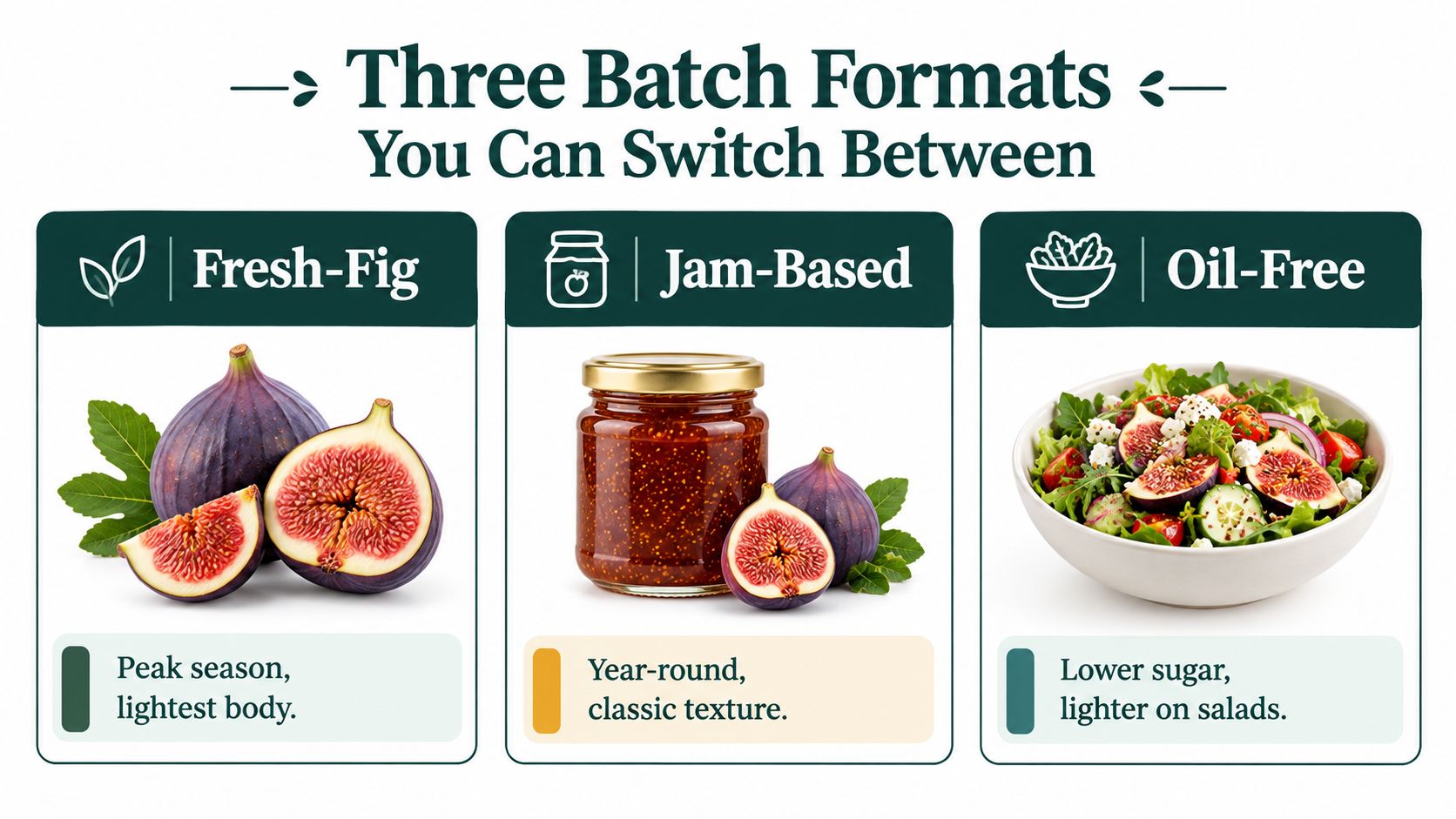
Choose the format before mixing. Fresh figs, jam, and an oil-free fruit base aren't interchangeable ingredients with identical results. They require different texture adjustments, and oil-free does not automatically mean lower-sugar.
The comparison graphic shows the paths; its lower-sugar description should be treated as a formulation choice, not a guarantee.
Fresh-Fig and Jam-Based Batches
For fresh-fig dressing, remove the stems and blend the fruit with balsamic, Dijon, and salt. Add water only as needed to make the base workable, then follow the oil-stream method. Sieve it if you prefer a smoother finish.
Expect the appearance to depend on the figs themselves, with visible specks if you retain the solids. Don't promise yourself the lightest texture because the fruit is fresh. Adjust until it pours comfortably and coats the food without landing in blobs.
The jam-based version is the practical cupboard option. Whisk preserves into the vinegar and mustard before adding oil, and hold back extra sweetener. Les Confitures à l'Ancienne Fig Jam is a French-made option containing cane sugar, figs, concentrated lemon juice, and fruit pectin.
Use its sweetness as part of the formula. The goal is a savory vinaigrette, not diluted jam; if it tastes too sweet, reassess the fruit quantity before adding more oil to hide it.
Oil-Free Dressing Needs Its Own Balance
Leave out the oil and blend the fig ingredient with balsamic, mustard, salt, and enough water for the intended consistency. Aim for a spoonable sauce rather than trying to reproduce an oil-based mouthfeel.
Removing oil doesn't settle the nutrition question. The Cleveland Clinic's fat-free fig, prune, and balsamic dressing contains 10 g sugar and 60 calories per 1.5-tablespoon serving. Compare ingredients and portions, not just the oil-free label.
Batch choice: Pick the texture you need, then manage sweetness separately.
For safety assessment, measure the finished dressing's equilibrium pH, not the vinegar alone. Acidified-food guidance uses a maximum pH of 4.6, with many formulations targeting 4.2 or lower for additional margin, but shelf stability still requires a validated process, as outlined in the University of Wisconsin's acidified-sauce guidance. Refrigerate homemade batches unless a validated process specifically supports another approach.
Pairing It With Salads, Boards, and the Rest of the Table
Serve fig balsamic dressing where its sweetness has something savory to meet. Bitter greens, salty cheese, and cooked meat make more useful starting points than a salad already crowded with sweet fruit and candied toppings.
For a weeknight bowl, toss bitter greens lightly, then add shaved Parmigiano. Taste a dressed leaf with the cheese before adding more salt. The dressing should season the greens, not collect underneath them.
Dress the Plate According to Its Texture
With heirloom tomatoes and burrata, arrange the food first and drizzle around and over it. Finish with fleur de sel, tasting before adding another pass of dressing. I'd dress that plate shortly before serving rather than leave it sitting in a deep puddle.
Roasted root vegetables suit a more generous coating. Toss them while plating, keeping some browned surfaces exposed instead of covering everything in a thick fruit layer.
- Grilled chicken or pork works with dressing spooned alongside or over the cooked meat. Keep any portion that contacted raw meat separate from the serving dressing.
- Bread needs a pourable version for dipping. A chunky fresh-fruit batch is better spooned onto toast.
- Cheese boards benefit from restraint. Put the dressing in a small serving dish so guests can choose how much accompanies blue, goat, or aged hard cheese.
For more cheese-board combinations, consult the guide to what to eat with fig jam. Keep the dressing's acidity in mind when adapting a pairing built around preserves.
If the plate already tastes sweet, add a savory counterpoint before adding more dressing.
Use a Mist Where a Pour Is Too Much
Delicate leaves call for especially controlled application. Mantova Italian Dressing Spray, EVOO & Balsamic of Modena combines extra-virgin olive oil and balsamic vinegar in a fine-spray format intended for light, even coverage.
It isn't a fig dressing, but it offers an alternative serving strategy: lightly dress the leaves, then add figs separately. Don't assume homemade fruit dressing will work in a spray bottle; fruit particles can obstruct dispensing openings. A spoon or small pouring jug is the more practical choice for the homemade batch.
Storage, Shelf Life, and How to Tell When It's Done
A jar of homemade dressing doesn't inherit the storage life of its unopened ingredients. Once you combine fruit, vinegar, mustard, oil, and possibly water or other additions, you have a different preparation.
The discussion of making and storing fig balsamic dressing highlights why fresh-fruit, jam-based, and commercial formulations shouldn't receive interchangeable storage advice. There isn't a defensible universal refrigerator window for every homemade version.
Give Each Jar a Clear Storage Plan
Use a clean container, refrigerate promptly, and label the preparation date and ingredients. Make a batch sized for meals you've planned rather than filling a large bottle on optimism.
| Batch format | Practical storage decision |
|---|---|
| Fresh-fruit | Make conservatively and plan its use promptly; don't borrow a preserves-based estimate |
| Jam-based | Refrigerate the finished mixture; the jam's original storage instructions aren't the dressing's shelf life |
| Oil-free | Keep refrigerated; removing oil doesn't validate longer storage |
The pantry refrigeration guide is useful for deciding where ingredients belong before mixing. For the finished homemade dressing, cold storage remains the default.
Olive oil may thicken in the refrigerator. Let only the serving portion soften enough to pour, then remix it without aggressive heating. Separation alone isn't proof of spoilage, but it also isn't proof that a forgotten jar remains safe.
- Discard for visible mold, rather than removing the affected surface.
- Discard for unexpected fizz or a yeasty, fermented, or otherwise off odor.
- Don't taste a suspect batch to decide whether it's acceptable. A normal appearance cannot establish safety.
Questions That Come Up After the Jar Is Made
Can you freeze it? Freezing isn't my first choice when texture matters. Without a tested freezing method for your formula, make a smaller fresh batch instead.
Can you can it at home? Don't improvise a canning process. Use a tested recipe specifically intended for preservation.
Can you rescue a split batch? If it's otherwise sound and properly handled, whisk or blend it back together. That fixes texture, not unsafe storage.
Can children or pregnant guests eat it? Those labels alone aren't a reason to exclude a properly handled dressing. Check ingredient allergies and individual dietary guidance, and serve a freshly prepared batch when storage history is uncertain.
Lello.Store offers olive oils, balsamic vinegars, fig preserves, mustard, and finishing salts for building a useful dressing pantry. Visit Lello.Store to choose ingredients for your preferred batch format, then plan a salad or cheese plate that puts the jar to work.