

Why can a few drops of olive oil with white truffle dominate dinner, while a generous pour of ordinary olive oil makes it richer? The difference starts with aroma, not luxury. Understanding that distinction makes the bottle easier to buy, easier to use, and much less likely to overwhelm good food.
My kitchen rule is simple: dinner should still taste like dinner. Truffle oil belongs in the pantry as a controlled finishing accent, not a test of how much truffle fragrance a plate can carry.
Table of Contents
- What White Truffle Olive Oil Actually Is
- Why a Few Drops Can Change a Whole Plate
- Infusion, Extract, or Just Flavoring
- How to Read a Truffle Oil Label Honestly
- Where White Truffle Oil Actually Earns Its Place
- White Truffle, Black Truffle, and Plain EVOO Compared
- Why Dose and Timing Matter More Than Heat
- Buying, Storing, and a Last Mental Model
What White Truffle Olive Oil Actually Is
White truffle olive oil is a flavor category, not a uniform recipe. The name alone doesn't tell you whether the bottle contains white truffle, another truffle species, an extract, added flavoring, or some combination. A peer-reviewed review of truffle chemistry and flavored oils makes the central distinction clear: a recognizable truffle aroma doesn't automatically mean olive oil infused exclusively with fresh Tuber magnatum, the white truffle.
Think of the bottle as having a base and an aromatic component. The olive oil supplies the oil itself, including its texture and underlying flavor. The truffle ingredients or flavoring supply the intended truffle impression.
The bottle's appearance can suggest a relationship between those components, but the ingredients tell you more.
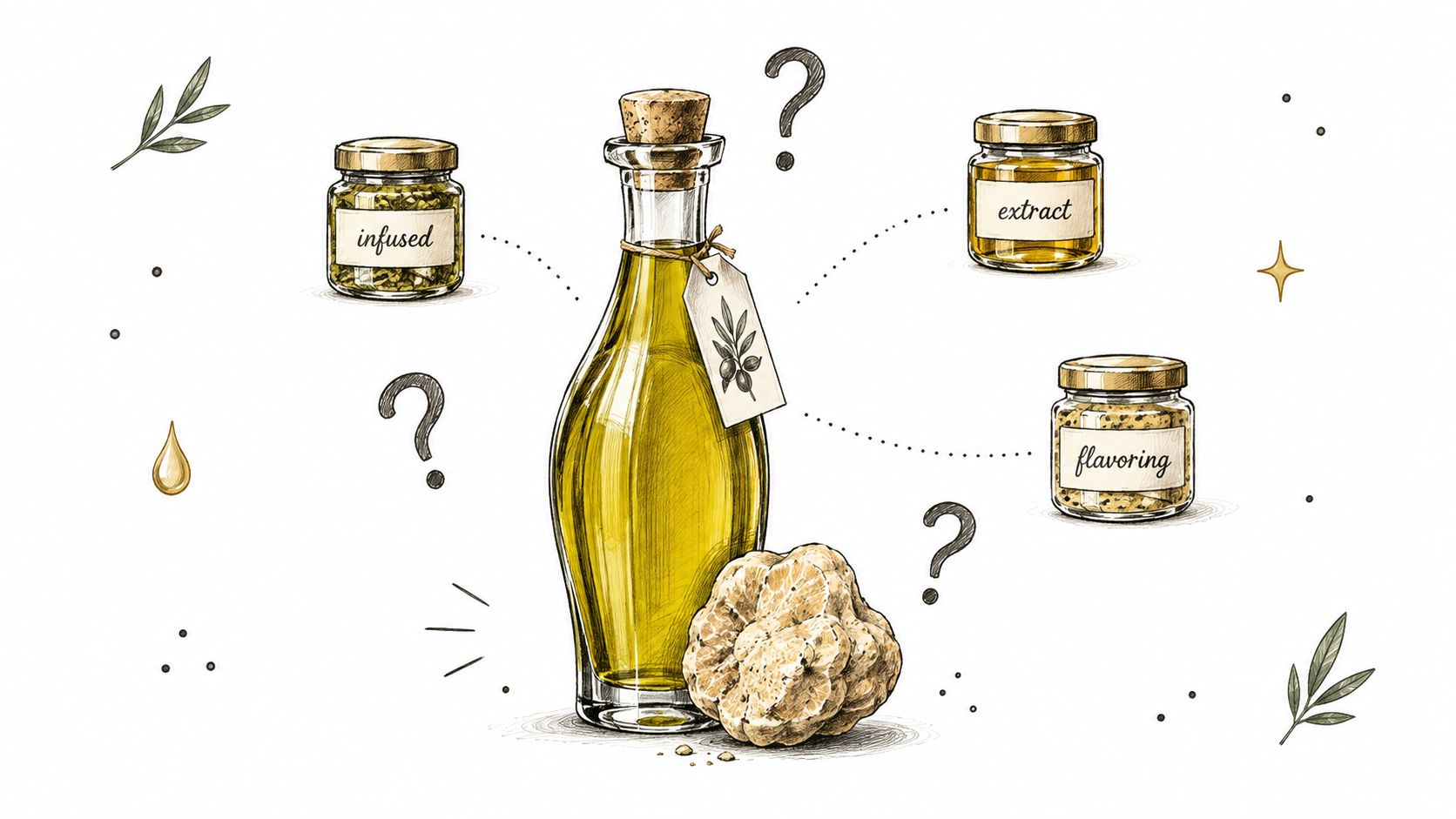
Separate the questions before judging the bottle
- What is in it? Identify the carrier oil, named truffle ingredients, and any added flavoring.
- What does it taste like? Judge whether the aroma feels integrated with the oil rather than assuming that greater pungency means greater quality.
- What will you use it for? Buy it for foods you already enjoy, such as eggs, potatoes, pasta, or risotto, rather than an imaginary special occasion.
A flavored oil doesn't have to imitate every aspect of fresh truffle to be useful. It does need an honest description and a sensible place in your cooking.
Pantry perspective: Treat the bottle as a way to add a particular aroma, not as proof that you've bought the fresh-truffle experience.
That framing removes a lot of unnecessary anxiety. You're choosing a condiment for a job, not collecting a culinary credential.
Why a Few Drops Can Change a Whole Plate
The signature white-truffle impression is strongly associated with 2,4-dithiapentane, a sulfur-containing volatile compound. Other sulfur compounds and alcohols contribute mushroom-like, garlic-like, and earthy notes, according to a scientific review of truffle aroma compounds. The important word for a cook is volatile: these compounds readily enter the air, where you can smell them.
This map connects that chemistry to what happens over a plate.
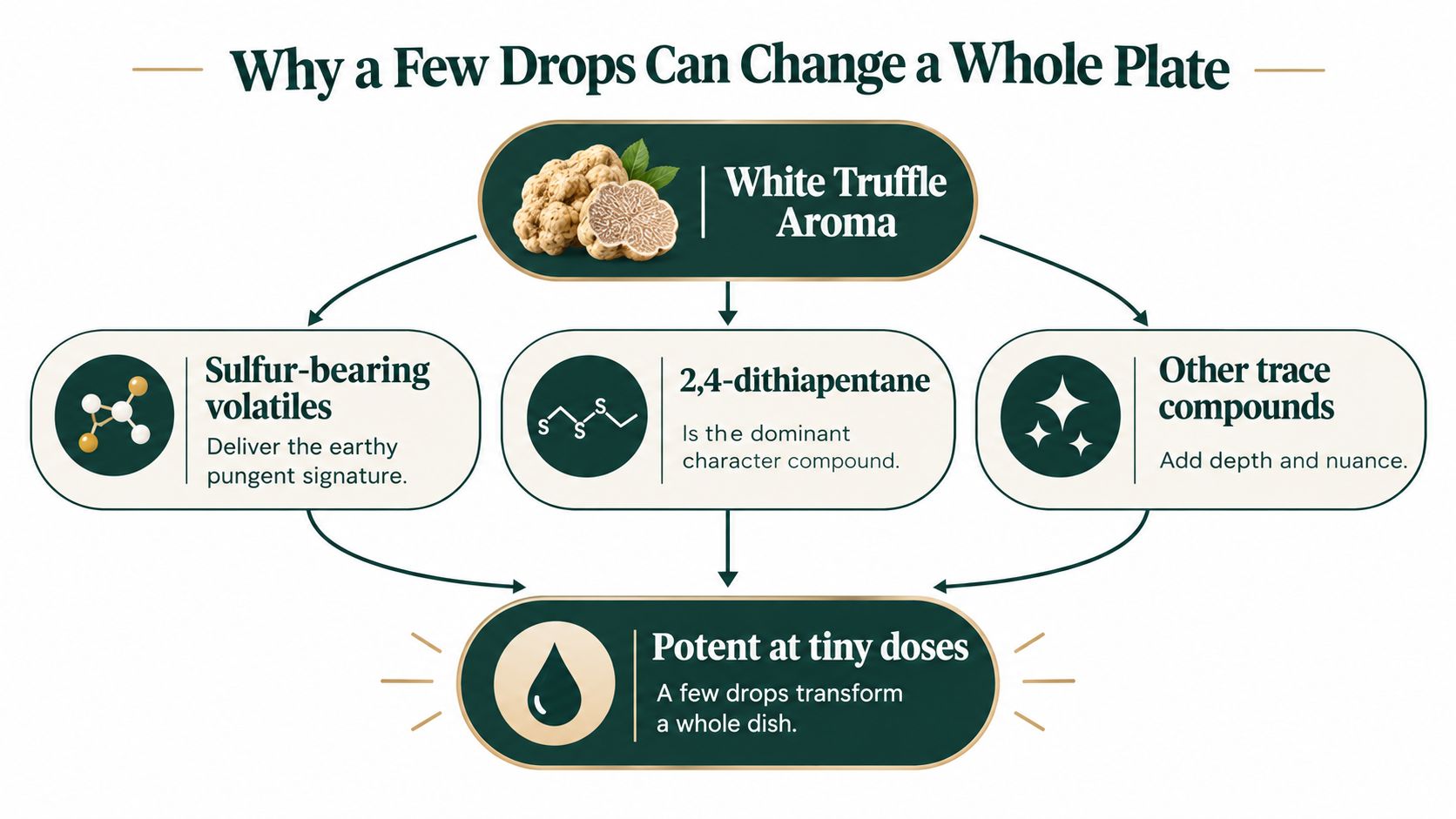
A small addition can therefore change the impression of a dish without supplying much oil. You're not trying to coat every strand of pasta with truffle oil. You're adding enough aromatic material for the finished plate to smell recognizably different.
Strong isn't the same as complex
Fresh truffle has a broader aromatic composition than its best-known molecule. A product that emphasizes the dominant note can smell forceful without reproducing that wider character. This explains an otherwise confusing experience: an oil can smell intensely “truffly” yet feel less nuanced than you expected.
Aim for proportion, not maximum intensity. The useful endpoint is a truffle note that belongs with the food and leaves the olive-oil base coherent. A sharp sulfur impression that pushes everything else aside isn't evidence of superior ingredients.
Heat also changes the calculation. Because those aroma compounds are volatile, adding the oil during high-heat cooking can send more of the fragrance into the kitchen rather than preserve it for serving. That's why finishing use makes better sense than using it as a sauté medium.
Keep that distinction in mind while watching this accompanying video.
The practical consequence is reassuring: you don't need a large pour to make the bottle useful. You need control over where its aroma lands.
Infusion, Extract, or Just Flavoring
An oil containing truffle pieces, an oil made with an infusion, and an oil containing added aroma aren't interchangeable descriptions. Nor are they necessarily separate categories. A producer can combine actual truffle ingredients with flavoring in the same bottle.
There's a sourcing reason to distinguish them. INRAE's account of controlled white-truffle production describes the difficulty of cultivating Tuber magnatum reliably and the constraints on natural supply. Reproducing a characteristic aroma offers a different commercial proposition from depending on fresh white truffles.
The visual categories below are useful vocabulary, but they shouldn't be read as an authentication ladder.
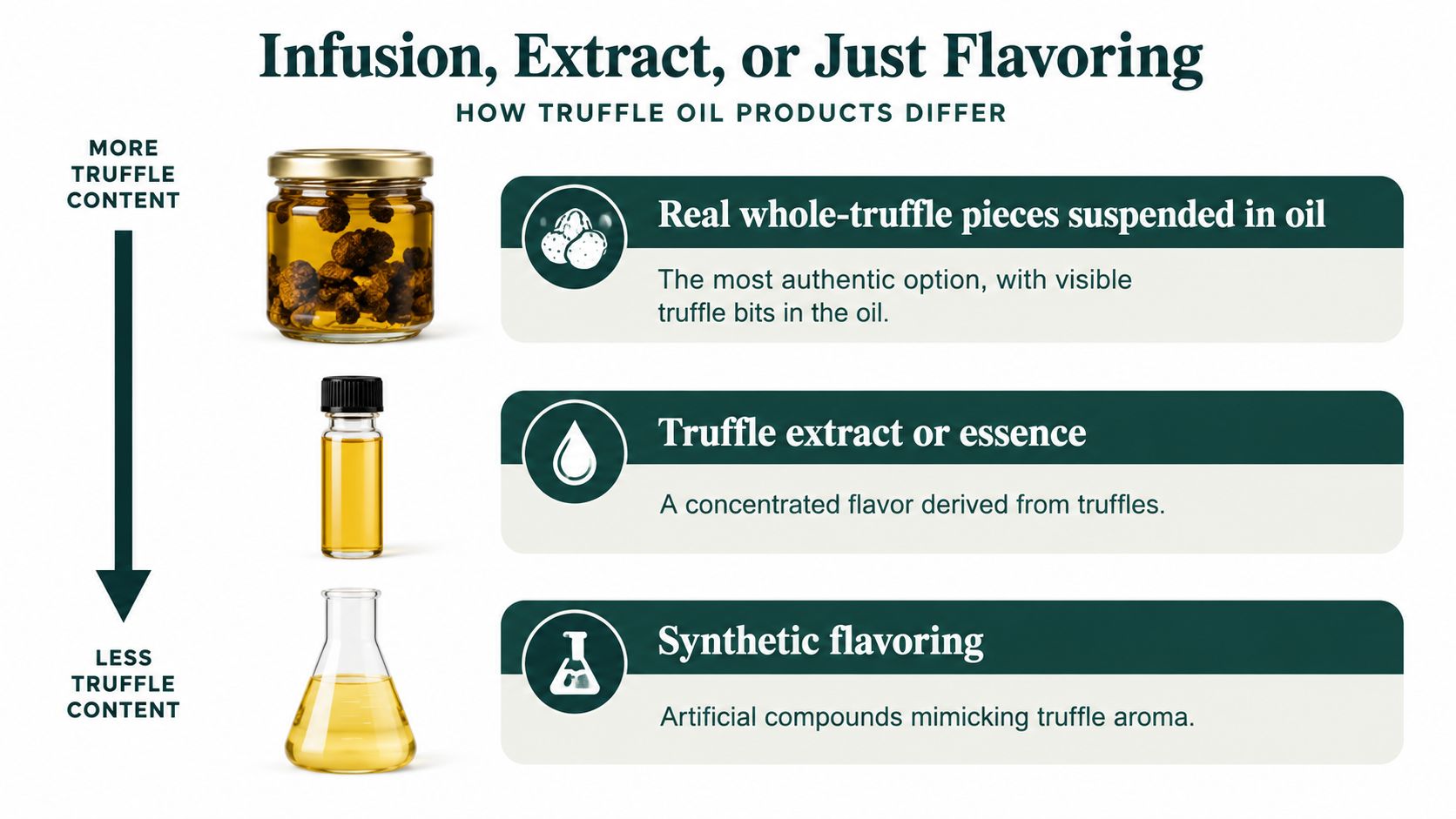
Read the method, not just the category
- Truffle pieces identify a solid ingredient in the bottle. Their appearance alone doesn't establish how the rest of the aroma was produced.
- Infusion describes an ingredient or process involving truffle and oil. Look for the species and fuller ingredient declaration.
- Extract identifies a concentrated truffle-derived ingredient, but the word alone doesn't reveal its concentration or the complete formula.
- Flavoring describes an added aromatic component. Don't assume its origin from the front-label language.
A concrete example is Il Boschetto Truffle Infused Extra Virgin Olive Oil, whose ingredient declaration lists 97% extra virgin olive oil, 2% summer-truffle infusion (Tuber aestivum), and 1% flavoring. That's a documented blend, not a pure white-truffle infusion, and the summer-truffle species matters.
This doesn't make it an unsuitable condiment. It makes it a different product from what someone might imagine after hearing “white truffle oil.”
The same habit of separating the base oil from the flavoring method is useful when considering other infused oils, including basil olive oil and how to use it. Buy the declared composition, not the picture you've formed from the name.
How to Read a Truffle Oil Label Honestly
Turn the bottle around before deciding whether it deserves pantry space. The front label tells you the intended identity; the ingredient declaration gives you a better basis for evaluating it.
Start with species and composition. Tuber magnatum identifies white truffle, while Tuber aestivum identifies summer truffle. If the label provides a percentage, check what it describes: truffle itself, an infusion, or another prepared ingredient.
Use a label-reading checklist
- Named truffle ingredient. Look for species, percentage where stated, and whether the ingredient is described as pieces, infusion, or extract.
- Added flavoring. Note it separately rather than mentally counting it as fresh truffle.
- Carrier oil. Check whether the base is extra virgin olive oil or another declared oil.
- Producer and origin. Distinguish where the finished product was made from any specifically documented origin of its ingredients.
- Production information. Look for harvest, production, or other dating details that help you understand what you're buying.
The oil grade deserves attention because the base remains part of every bite. A truffle fragrance doesn't make the carrier irrelevant. For a broader buying framework, use this guide to choosing extra virgin olive oil.
What the label can't prove by appearance
Visible shavings can feel reassuring, but they aren't a complete authentication method. Likewise, finding the signature aroma molecule doesn't establish meaningful fresh-white-truffle content.
An analytical comparison of commercial and homemade truffle oils found that stable-carbon-isotope analysis didn't reliably distinguish naturally derived from synthetic versions of the signature compound. Broader aroma profiling was more informative than relying on that marker alone.
A fragment in the bottle tells you less than a clear ingredient declaration backed by a producer who can explain it.
If a seller's description leaves the formula ambiguous, ask directly: Which truffle species is present? In what form? Is there added flavoring? What is the base oil?
You don't need laboratory-level certainty to choose dinner's finishing condiment. You do need enough information to avoid paying for an assumption.
Where White Truffle Oil Actually Earns Its Place
A plain risotto is a useful starting point. Finish the rice, get its seasoning and texture right, and plate it before considering the truffle oil. Add a restrained touch to a small area and taste that mouthful against an untouched one.
With soft scrambled eggs, I'd make the same comparison after cooking rather than pouring oil into the eggs automatically. The question isn't whether you can detect truffle. It's whether you prefer the eggs with it.
Try it where the decision is easy to taste
- Mashed potatoes. Dress a little of the plated mash rather than committing the whole serving bowl. Keep the butter and seasoning where you already like them.
- Buttered popcorn. Toss a small portion with a restrained addition before seasoning the entire bowl. Treat this as a tasting experiment, not a reason to pour freely.
- Mushroom pasta. Finish the sauce first, then decide whether the truffle aroma adds something distinct. This creamy mushroom pappardelle with truffle oil provides a concrete dish for practicing that judgment.
Those are suggested kitchen tests, not universal recipes. Bottle strength and personal preference can change the result, so a comparison bite is more useful than a rigid instruction.
Give the aroma room
The chemistry discussed earlier favors relatively neutral foods rather than heavy spice or a strongly assertive oil base. My preference is to start with starches, eggs, mild cheese, or prepared vegetables, then decide whether more complicated pairings are worthwhile.
I wouldn't make a sharply acidic salad the first test of a new bottle. Not because acidity makes truffle oil unusable, but because I'd rather learn its character without a forceful dressing competing for attention.
At the stove: Finish the food so it tastes good without truffle oil. Then decide whether the addition makes it better.
That protects both ingredients. The oil becomes an option rather than a rescue attempt.
White Truffle, Black Truffle, and Plain EVOO Compared
Choose among these oils by the job you want done, not by a presumed luxury ranking. Truffle-flavored oils make the most sense when you want their declared aromatic character; plain extra virgin olive oil makes sense when you want the olive oil itself to lead.
The distinction between white- and black-truffle oils also needs care. A species name helps identify ingredients, but added flavoring can shape the finished aroma substantially. Don't assume the category guarantees a particular tasting experience.
White Truffle, Black Truffle, and Plain Extra Virgin Olive Oil
| Attribute | White Truffle Oil | Black (Summer) Truffle Oil | High-Quality Plain EVOO |
|---|---|---|---|
| Intended aroma | White-truffle-style character | Summer- or black-truffle-style character | Olive-oil character |
| Composition check | Look for white-truffle species and any flavoring | Look for the named species and any flavoring | Confirm the oil's identity and grade |
| Base quality | Check the declared carrier oil | Check the declared carrier oil | The oil itself is the main choice |
| Price judgment | Don't infer fresh-truffle content from price | Don't infer concentration from category | Assess the producer's stated oil details |
| Suggested starting dish | Plain risotto or eggs | Mushroom pasta or potatoes | Any dish where you want olive flavor |
| Main decision | Do you want this aromatic accent? | Does this particular bottle suit the food? | Do you want an unflavored oil? |
Don't turn category names into cooking rules
I wouldn't give black-truffle oil more heat because its name sounds heartier. Its actual formulation matters, and the finishing approach remains the sensible starting point for preserving aroma.
Likewise, “white” doesn't mean a commercial oil will necessarily taste delicate. A powerful flavoring can make a supposedly delicate category quite assertive.
For an everyday pantry, my preference would be to choose a plain extra virgin olive oil independently, then add a truffle condiment only if there are meals you want to finish with it. They serve different purposes. Neither needs to replace the other.
Why Dose and Timing Matter More Than Heat
Once you've decided to finish rather than fry with the oil, the useful variables are how much you add and when you add it. There's no reason to chase a hot-pan technique to make the product work.
Use the following visual as a reminder of the method, not as a universal dose chart. Different bottles can warrant different amounts.
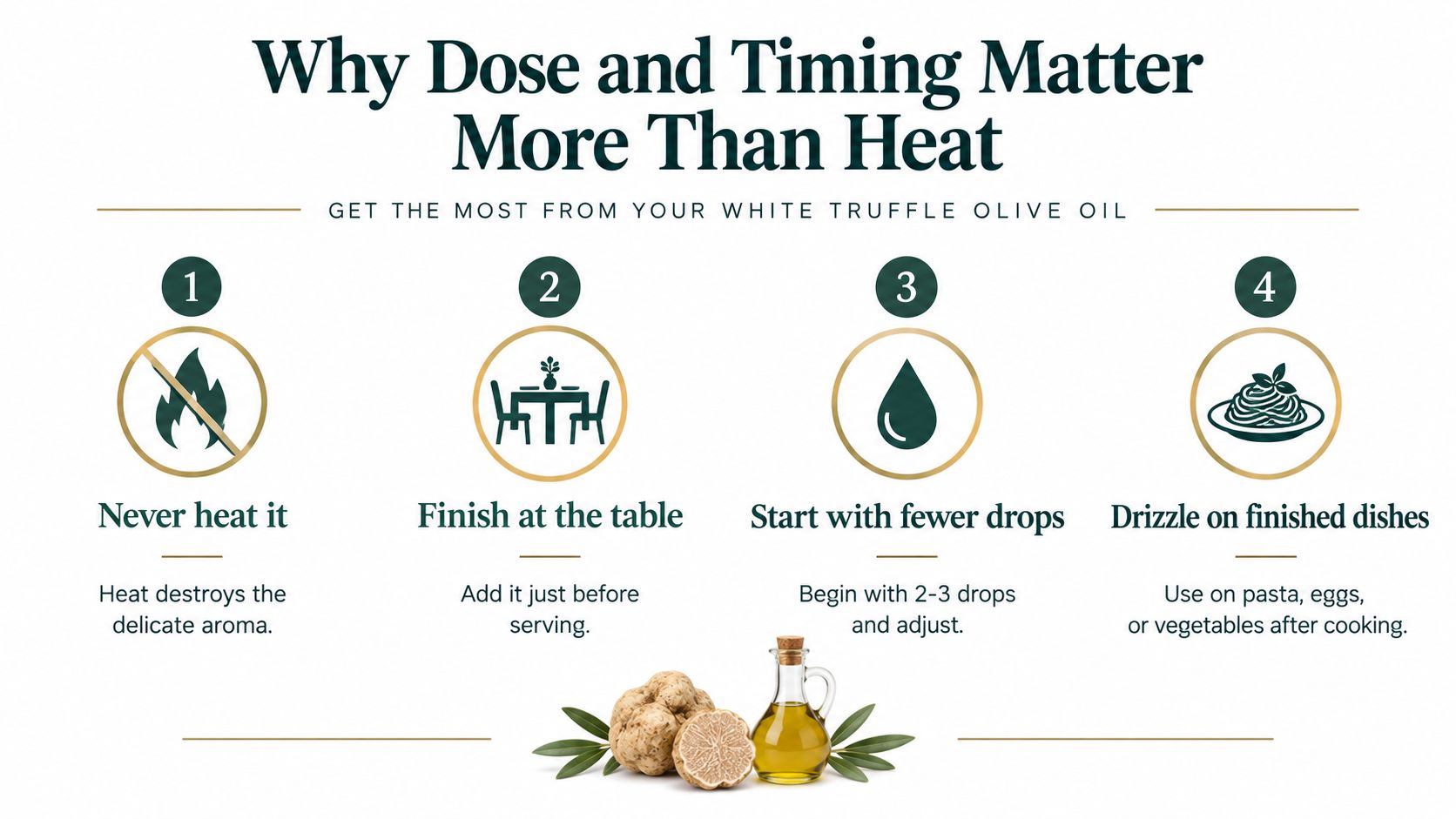
Build a tasting ladder rather than memorizing a measure
- Prepare the dish completely. Adjust salt, sauce consistency, butter, or ordinary olive oil before adding the truffle accent.
- Make a small test. Put a little finished food on a spoon or side plate and add the smallest controllable touch.
- Compare before scaling up. Taste the test beside the unflavored food. Add to the main portion only if you prefer the change.
- Serve without another cooking stage. Don't return the finished dish to heat merely to “activate” the oil.
Scale to the food, not the bottle's pour
For scrambled eggs, test the cooked eggs before dressing the plate. For pasta, finish tossing with its sauce and pasta water before making your comparison. This recipe for truffle soft scrambled eggs offers a focused way to practice the timing.
For popcorn, toss a trial portion so you can judge distribution. For mashed potatoes, compare a dressed forkful with a plain one rather than assuming a larger bowl requires an automatic generous drizzle.
Keep richness and aroma separate. If the dish needs more butter, sauce, or plain oil for texture, fix that directly. Don't use extra truffle oil to solve a moisture problem.
The stopping point is the first addition you prefer, not the strongest aroma you can achieve.
Buying, Storing, and a Last Mental Model
Buy a bottle for the meals you make. If eggs, pasta, potatoes, or risotto already appear in your kitchen, you have practical opportunities to use it. If none of those foods appeals, a prestigious-looking bottle won't create a useful habit.
My buying preference is a manageable bottle with an intelligible ingredient list, a clearly identified base, and producer instructions I can follow. I'd choose that over grand language about authenticity that never explains the formula.
Give the bottle a realistic place in the pantry
- Store according to its label. Keep it cool and dark where instructed, and close it promptly after use.
- Follow its after-opening guidance. Use the producer's stated window rather than borrowing one from an unrelated product.
- Keep the instructions accessible. If the bottle came in packaging with storage details, save those details before discarding it.
For broader questions about shelf life, this guide to whether olive oil expires is a useful companion. Don't confuse a product's aromatic purpose with an excuse to ignore its base oil or storage instructions.
Flavor isn't a wellness claim
Treat olive oil with white truffle primarily as a flavor accent, not a source of special truffle nutrition. The American Chemical Society's overview of 2,4-dithiapentane helps identify the aroma compound, but it doesn't establish a special nutritional benefit from adding that aroma to dinner.
There's no need to turn an ordinary condiment into either a health product or a cause for alarm. Judge it on transparent composition, appropriate handling, and whether you enjoy what it contributes.
The durable mental model is an aroma-delivery system with an olive-oil base. At the table, ask whether it finishes the dish or fights it. Your next bite is a better answer than another enthusiastic pour.
Lello.Store offers a curated selection of olive oils, infused oils, finishing salts, and pantry staples alongside practical cooking guides. Visit Lello.Store to choose a finishing oil for the meals you already cook, then try it on a small portion before dressing the whole plate.