

Most bartending advice tells you to memorize more drinks. Don't. A home host who knows eight family ratios can make the drinks guests ask for, adjust them when a bottle is missing, and serve a lighter round without handing someone a watery glass. Tape one short card inside a cabinet door. Pick the family first, measure with a jigger, and let the named recipes work as examples of each row. That's the whole bartending cheat sheet worth keeping.
Table of Contents
- Spirit to Mixer Ratios at a Glance
- Ten Specs Worth Keeping on the Card
- Glassware Garnish and Ice by Job
- Substitutions That Hold the Balance
- Fixes When a Drink Misses
- Batch Math for Four to Twelve Guests
- Lower Strength Builds That Stay Flavorful
- Set Out the Bar and Know When to Stop
Spirit to Mixer Ratios at a Glance
Choose a family row before you choose a brand. A Manhattan request puts you on the stirred spirit-forward row. Something bright and cold means the sour row. A long drink to sip through dinner prep means the highball or spritz row. Pick the wrong bottle and the drink tastes different; pick the wrong row and it tastes broken.
Measure every time. Free pouring feels confident and produces a different drink on every round, which matters most in sours, where a small excess of citrus can swamp the spirit. A jigger also lets you repeat the version a guest liked. Without one, you're guessing at what you poured ten minutes ago.
The Card to Tape Inside a Cabinet
| Family | Ratio | Example build | Method | Glass |
|---|---|---|---|---|
| Stirred spirit-forward | 2:1 spirit to vermouth; dry martini 5:1 to 8:1 | Manhattan 2 oz rye, 1 oz sweet vermouth, 2 dashes bitters | Stir | Coupe or Nick and Nora |
| Old Fashioned | 2 oz spirit, 1/4 oz rich syrup or 1 cube, 2 to 3 dashes | Bourbon or rye Old Fashioned on one large cube | Build | Rocks |
| Equal-parts bitter | 1:1:1 | Negroni 1 oz gin, 1 oz Campari, 1 oz sweet vermouth | Stir | Rocks |
| Sour | 2:1:1 spirit, citrus, 1:1 syrup | Whiskey sour 2 oz, 1 oz lemon, 3/4 to 1 oz syrup | Shake | Coupe or rocks |
| Daiquiri | 2:1:0.75 | 2 oz white rum, 1 oz lime, 3/4 oz simple | Shake | Coupe |
| Highball | 1:2 to 1:3 | 2 oz gin or whiskey, 4 to 6 oz tonic or soda | Build | Highball |
| Spritz | 3:2:1 wine, bitter, soda | 3 oz prosecco, 2 oz aperitivo, 1 oz soda | Build | Wine glass |
| Sparkling sour | Spirit and citrus first, wine last | French 75: 1 oz gin, 1/2 oz lemon, 1/2 oz syrup, 2 to 3 oz Champagne | Shake, then top | Flute |
Read the table from left to right. The family gives you the structure, the ratio gives you the pour, the example shows one concrete drink, and the method tells you how cold, air, and bubbles enter the glass. Find the row for the drink a guest wants and work across it.
How the Rows Differ in Practice
The stirred spirit-forward row has the widest range on the card. A Manhattan sits at the vermouth-heavy end, and a dry martini slides the other way because the guest wants the gin forward and the wine as seasoning. Don't split the difference without asking. At 2:1 a martini tastes wet and herbal; at 5:1 the vermouth drops to seasoning and the gin leads.
On the Old Fashioned row the whiskey stands alone, so the syrup and bitters season it rather than share it. Sweeten the whiskey with vermouth instead and you've crossed rows into Manhattan territory. The equal-parts bitter row works the opposite way: no single bottle hides, so a tired vermouth or a harsh gin shows up immediately.
Sours are the least forgiving row because fresh citrus is a third of the drink, not a garnish. I keep the syrup tight unless someone asks for a soft, round drink. A whiskey sour can take the upper end of the range; a daiquiri should stay at the lower end and taste dry and snappy rather than like limeade.
The long rows lengthen a drink instead of intensifying it, so most of the glass is mixer and temperature matters more than bottle choice. A warm tonic flattens the pour no matter which gin you own. On the sparkling row the wine goes in last, after the shake, so the bubbles survive the trip to the glass.
Pick the row, then the bottle. If you reverse that order, you'll keep forcing the spirit you own into drinks it doesn't suit.
Eight rows cover an evening. Once they're familiar, you can make a drink you haven't memorized by asking one question. Is it stirred and spirit-led, shaken with citrus, built long, or topped with something sparkling? The answer puts you on a row, and the row gives you the pour.
Ten Specs Worth Keeping on the Card
Ten specs cover an evening because each is one family row applied to a named drink. The card's job is to carry what the ratio table can't: how long to stir, when to double-strain, and the mistake that ruins the drink. Volumes live in the rows above; execution lives here. Start with the visual version of the set, then work through the specs in the order you'd make them during an evening.
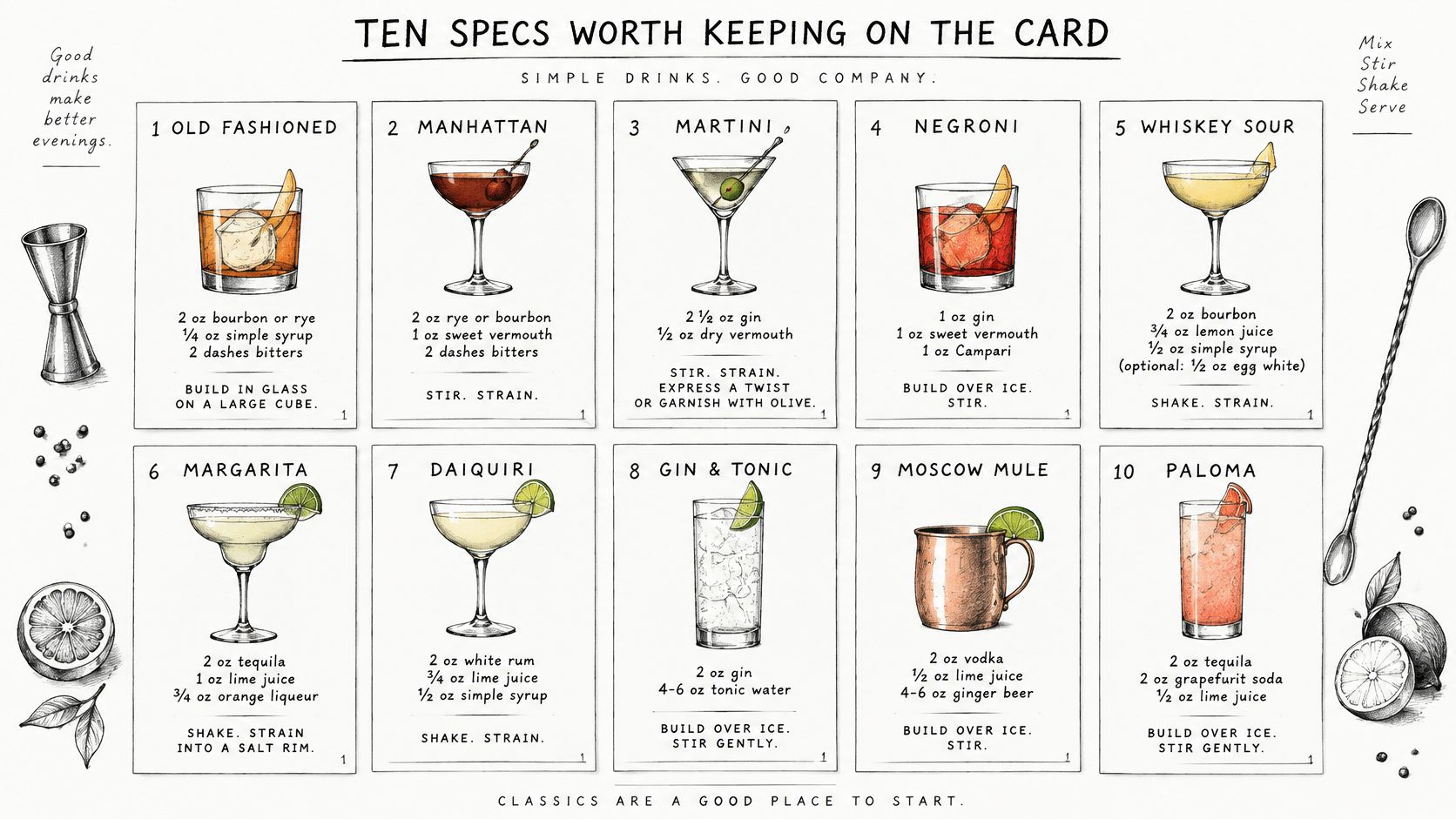
The format matters more than the number. According to the IBA official cocktails specifications, a recipe identifies the drink category, exact volumes, glassware, ice condition, method, and garnish, and the IBA Americano uses 3.0 cl Campari, 3.0 cl sweet red vermouth, and soda water, built directly in an ice-filled old-fashioned glass. Write your own cards the same way, with fields for spirit, modifier, acid or sweetener, carbonation, glass, ice, technique, and garnish. A list of ingredients without method will fail you mid-service.
Stirred and Built Cards
- Old Fashioned, built: Build in a rocks glass directly on one large cube, stir briefly in the glass, and express orange peel over the top. The common failure is over-stirring, which turns a spirit-led drink watery before the first sip.
- Manhattan, stirred row: Stir 20 to 30 seconds with plenty of ice, strain up into a chilled coupe, and garnish with a cherry. Under-stirring leaves it warm; a sweet vermouth past its prime reads flat no matter how long you stir.
- Martini, stirred row: Use the 5:1 to 8:1 dry end of the row with gin and dry vermouth. Stir, strain up, and finish with a lemon twist or an olive. Offer both only if the guest asks.
- Negroni, equal-parts row: Stir with ice and serve on a large cube with orange peel or an orange half-slice. The common failure is building it warm over fresh ice and skipping the stir, which leaves the first sip undiluted and harsh.
- Americano, built row: Follow the IBA pattern of equal Campari and sweet vermouth lengthened with soda, built in an ice-filled old-fashioned glass with an orange half-slice and a lemon twist. It's the Negroni's structure at lower strength, which is exactly the kind of version a small card should carry: same balance, longer drink, no extra recipe to memorize. Add the soda last and give one gentle lift with the bar spoon so the bubbles survive.
Watch the stirring and straining sequence once, then practice it with water and ice before guests arrive.
Shaken, Long, and Sparkling Cards
- Daiquiri, sour row: Shake hard with ice, strain into a coupe, and serve with no ice in the glass. The common failure is drifting toward the fuller syrup pour on the row; the tighter end is what keeps it dry and snappy.
- Whiskey sour, sour row: Shake hard and double-strain if the juice carries pulp. If you add egg white or aquafaba, dry shake first without ice, then shake again with ice to chill and dilute.
- Margarita, sour row: Orange liqueur does the syrup's job on this row, with an optional small agave pour if the liqueur is dry. Shake and strain over fresh ice rather than serving up, because pouring it over the spent shake ice thins the drink within minutes.
- Gin and tonic, highball row: Pour the tonic last over a full glass of ice and stir once. Warm tonic in a half-empty glass of ice is why home versions taste flat.
- French 75, sparkling sour row: Shake the still ingredients, strain into a flute, then top with chilled Champagne so the shake never touches the bubbles. A floral variation such as the rose confit French 75 recipe belongs on the card as a labeled house version, alongside the classic spec rather than in place of it.
The four method words do different jobs, so don't treat them as style choices. Shake aerates citrus and chills fast, which is what a sour needs. Stir chills a clear, all-spirit drink without foam or cloudiness. Build keeps carbonation in the serving glass because nothing gets shaken or strained. Top means the sparkling wine goes in last, after the still ingredients are already cold.
Label any change. A splash of brine in a martini, a preserve standing in for syrup, or a dehydrated citrus wheel instead of fresh peel can all work, but write house variation beside the canonical spec. Otherwise you'll forget which version you served, and a guest who asks for the same drink next month gets a different one.
Glassware Garnish and Ice by Job
Glass, ice, and garnish are fields on the spec, as real as the ounce measures. The wrong ice changes dilution within minutes. The wrong glass changes temperature and aroma. A card that decides these seven rows in advance beats a drawer of twenty garnish options you improvise under pressure.
| Structure | Glass | Ice | Garnish |
|---|---|---|---|
| Stirred, served up | Coupe or Nick and Nora | Stirring ice discarded; glass chilled | Lemon twist or cherry |
| Spirit on the rocks | Rocks glass | One large dense cube | Orange peel or expressed lemon |
| Sour up | Coupe | Shake ice, double strain, none in the glass | Fresh wheel or dehydrated wheel |
| Highball | Highball, about 10 to 12 oz | Glass filled with standard cubes | Citrus wedge matching the mixer |
| Spritz | Large wine glass | A few standard cubes | Orange half-slice |
| French 75 | Flute | No ice in the flute; shake ice stays in the tin | Long lemon peel |
| Savory martini | Coupe or Nick and Nora | Stir, serve up | Olive plus a measured brine splash |
Ice by Function and Safety
A stirred drink served up wants a chilled coupe or Nick and Nora with no ice in the glass. Park the glass in the freezer while you stir and it will hold temperature through the pour. The mixing ice did its work and gets discarded. A rocks drink wants one large dense cube so dilution stays slow while the guest talks. A highball wants the glass filled with standard cubes before the spirit goes in, because a fuller glass of ice melts slower than three cubes rattling in warm tonic.
Crushed ice is a deliberate choice where fast chill and fast dilution are the point, as in a julep. It will wash out a spirit-forward drink, and it does nothing for a sour that was already built wrong. Shake ice never returns to the bin: it's broken, wet, and carrying whatever was in the tin.
The FDA Food Code states that ice used as food or as a cooling medium must be made from drinking water, and ice used to cool exterior food surfaces, packaged beverages, or equipment cannot subsequently be used as food. In home terms, ice that chilled a bottle in a sink doesn't then go into a glass. Use a clean scoop or tongs rather than hands or the serving glass, and keep cut garnishes out of the ice bin. Write those rules on the card next to the ice types, where you'll see them while serving.
Garnish Matched to Structure
Match the garnish to what the drink lacks. A lemon twist gives aromatic lift to a stirred drink without adding juice. An orange half-slice suits an Americano or Negroni, where the bitter and sweet elements are already loud. A fresh wheel works on a sour you're serving immediately. When you're prepping hours ahead, guidance on dehydrated lemon peel points you to a garnish that holds its shape on the counter instead of wilting.
For a savory martini, use an olive and a measured splash of brine rather than a spoonful poured from the jar. A cherry earns its place in a Manhattan when it contributes flavor. One garnish per drink is enough at home, and a single crowded skewer usually signals the balance underneath wasn't trusted.
Tools follow the same logic. The A Bar Above Stirred Cocktail Set, Stainless Steel, 10 Pieces is a 10-piece stainless steel set for the stirred rows, sold for $54.00. It covers the stirred side of the card only, so you'll still want a tin for sours. Buy for the methods you pour, and skip whatever doesn't serve a row.
Substitutions That Hold the Balance
A thin home bar doesn't mean a failed round. It means every swap has to be a ratio decision. Replace a bottle with something that does the same job at a known volume, correct for sweetness or bitterness, and stop stacking fixes when two core bottles are missing. At that point, move to the highball or spritz row and make a drink you can execute.
| Missing | Swap | Volume note | Do not use it in |
|---|---|---|---|
| Sweet vermouth | Another Italian-style sweet vermouth | Keep the 1 oz in a Negroni | A dry martini |
| Red bitter | Similar red aperitivo bitter | 1:1 with the Campari slot | A gin and tonic |
| Orange liqueur | A drier orange liqueur | Add back about 1/4 oz syrup on the sour row | A stirred Manhattan |
| 1:1 simple syrup | 2:1 rich syrup | Use about 3/4 of the written volume | Unadjusted 1:1 measures |
| Fresh lemon | Bottled lemon the same day | Same ounce measure | Drinks batched overnight |
| Egg white | Aquafaba about 3/4 oz | Still dry-shake, then shake | Anything served still and clear |
| Champagne | Prosecco or cava | Top last, same 2 to 3 oz | Replacing bubbles with soda |
| Gin in a martini only | Vodka | Keep the 5:1 to 8:1 row | A Negroni |
Sweetness and Bitterness Corrections
Another sweet vermouth can stand in for the one named in a spec at the same volume. Dry vermouth cannot replace a full ounce of sweet vermouth in a Negroni without help, because you've removed both sugar and body. If you do it anyway, add a small syrup correction and write it down as a house variation. Pretending it's still a Negroni teaches you nothing about why it tastes thin.
A different red bitter can replace Campari at 1:1 if its bitterness sits in the same range. A pale, gentle aperitivo cannot, since the equal-parts row depends on that bitter slot pushing back against sweet vermouth. Orange liqueurs split the same way. Triple sec and a Cointreau-style liqueur aren't identical, and if your substitute is drier, borrow 1/4 oz from the sour sweetener row rather than pouring more liqueur. More liqueur adds alcohol and orange flavor when the drink only needed sugar.
Syrup strength is the quietest trap. Rich 2:1 syrup replaces 1:1 syrup at about three-quarters of the volume. Pour it ounce for ounce and every sour on the card turns soft. Note which syrup is in your squeeze bottle, in marker, on the bottle.
Swaps With Limits
Bottled lemon is a same-day stand-in at the same volume, not a pantry staple to build a card on. It gets you through one evening. It won't match fresh juice in a daiquiri, where citrus is a third of the drink. Aquafaba at about 3/4 oz replaces egg white and still needs the dry shake on the sour card. Skipping the dry shake gives you a thin foam that breaks in the glass.
Prosecco or cava can top a French 75 at the same volume, poured last. Soda cannot, because soda adds bubbles without the wine's acid, body, or flavor. Vodka can stand in for gin in a martini and nowhere else on this sheet. A Negroni without botanicals is a different drink wearing the wrong name.
Saline or a few drops of olive brine adds savor where a second modifier would only add sugar, and the martini olives guide is the place to sort out olive and brine choices before you start seasoning by instinct. Measure brine like an ingredient. If two bottles are missing, don't stack three corrections into one glass. Pour a highball or a spritz and serve something clean.
Fixes When a Drink Misses
A measured drink can still miss. Citrus varies, ice varies, and a substitute bottle rarely matches the original exactly. Change one variable at a time, taste, and write the correction on the card. Adjusting three things at once gives you a better drink and no idea why.
One Fix per Symptom
- Too sharp: Add 1/4 oz of 1:1 syrup on the sour row and shake again. More juice makes a sharp drink bigger, not softer.
- Too sweet: Cut the syrup back to 3/4 oz and check whether a bottled liqueur was swapped in at its written volume without a correction.
- Too strong or hot: Move the drink to the highball or spritz row, or add a measured splash of chilled water to a stirred drink and stir 10 seconds more. Dilution is an ingredient, so measure it.
- Watery: Your ice was too small or too warm. Use one large dense cube for rocks drinks and cut the stir time on the next round.
- Flat: The sparkling ingredient went in first or went in warm. Chill it, add it last, and build in the glass.
- Cloudy or foamy in a clear drink: You shook something that should've been stirred. Stir the next one, and double-strain any drink carrying pulp.
- Dull: Add a dash of saline or a splash of brine, or express a citrus twist over the surface, before reaching for more sugar. Dull usually means missing salt or aroma, not missing sweetness.
Taste before you fix: Take one small sip from a spoon or straw, name the single problem out loud, and correct only that.
Each fix points back to a ratio row, so return to the card and check the spec before improvising a second correction. If the same drink misses the same way twice, the card is wrong for your bottles. Change the card, not your memory of it.
Batch Math for Four to Twelve Guests
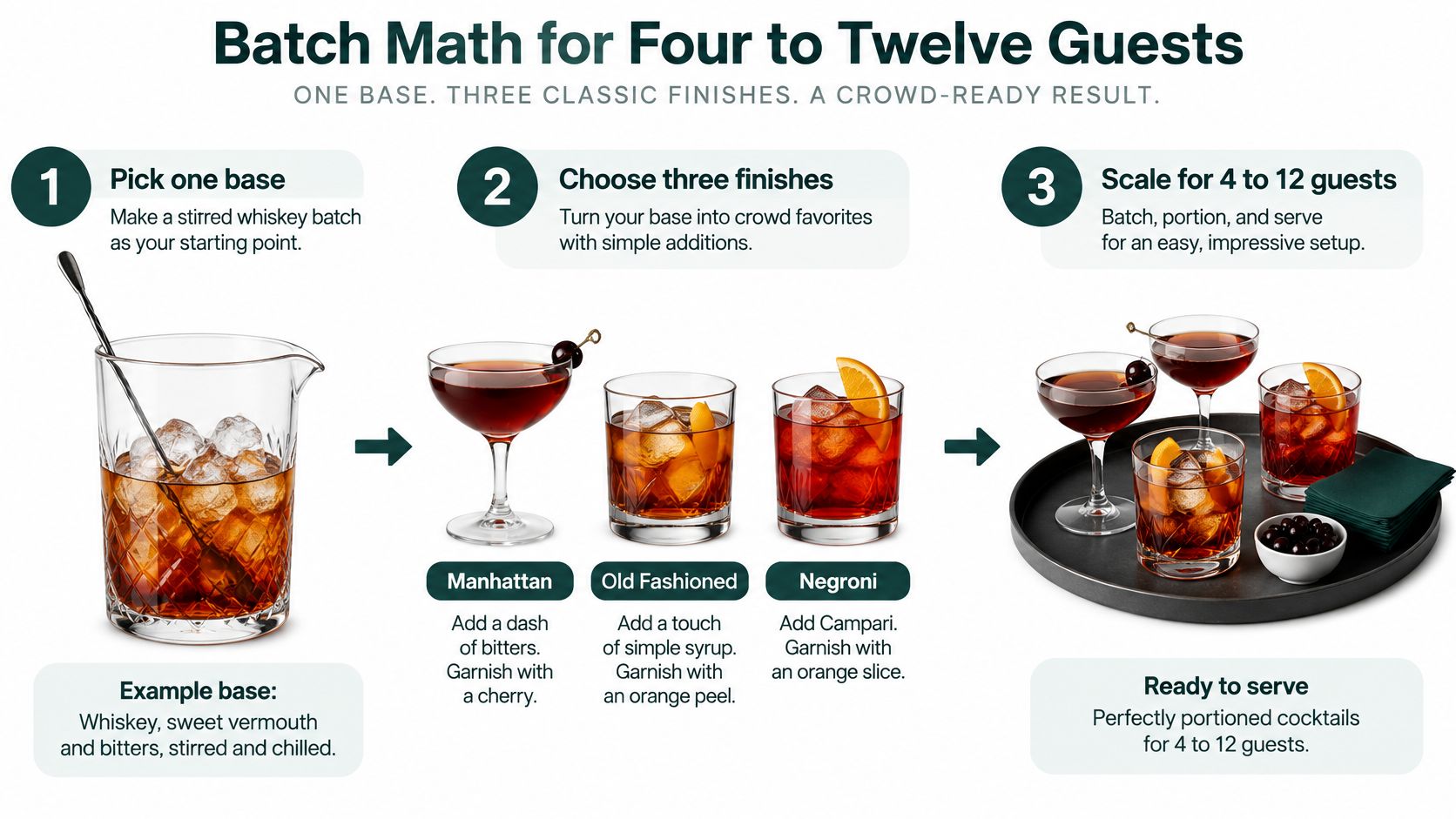
Batching doesn't need new recipes. It needs one ratio row multiplied cleanly, with dilution handled at serving time. Pick one base and three finishes. A stirred whiskey batch becomes a Manhattan as written, an Old Fashioned for guests who want it drier (bitters and syrup go in their glass), and a lower-vermouth pour for anyone who wants the whiskey forward. One bottle run, three drinks, no separate shopping list for each.
The flow below shows the sequence from base to tray, so you can set it up before the doorbell rings.
Cost is part of why this matters at home. According to NIQ's mixed drinks report, more than a quarter of consumers say cocktails are too expensive to drink throughout a visit or choose them only when they see a good range. A tight batch with a highball option beside it gives guests range without opening six bottles you'll never finish.
Multiply Everything but the Ice
| Guests | Rye (spirit) | Sweet vermouth | Bottles needed |
|---|---|---|---|
| 4 guests | 8 oz | 4 oz | One 750 ml spirit bottle |
| 6 guests | 12 oz | 6 oz | One 750 ml spirit bottle plus a small remainder |
| 12 guests | 24 oz | 12 oz | Two 750 ml spirit bottles and one vermouth bottle |
Multiply the spirit and modifier only. For four Manhattans at 2 oz and 1 oz, that's 8 oz rye and 4 oz sweet vermouth. For six, 12 oz and 6 oz. For twelve, 24 oz and 12 oz. Leave dilution out of the bottle and stir each round over ice at serving time, which keeps every glass at the same temperature and strength.
If the batch must be poured without a stir, add about 1/2 to 3/4 oz cold water per drink, then taste and adjust once. Pre-diluted batches keep drifting as they sit, so treat this as a service shortcut rather than a storage plan. Sours are the one build you shouldn't batch this way. Citrus juice is best the day it's squeezed, and an overnight sour batch tastes tired no matter how cold the fridge is.
Do the bottle math before you promise drinks. A 750 ml bottle holds roughly 25 oz, so twelve 2 oz pours use 24 oz of it. That leaves about 1 oz behind, less than a single pour and nothing for tasting, a top-up, or the glass that gets knocked over. Twelve guests is a two-bottle batch, and the vermouth needs a bottle of its own. Buying that second bottle in advance is cheaper than sending someone out mid-evening.
Prep Order for Service
- Chill first: Put glassware and the batch bottle in the fridge or freezer where they fit safely.
- Cut garnishes: Slice citrus, cover it, and refrigerate it. Set out shelf-stable garnishes such as Dehydrated Lime Wheels if you want garnish ready hours ahead.
- Stage ice: Fill the ice bin and set out a clean scoop where your hand naturally reaches.
- Pour still ingredients: Measure the batch into a clean bottle or pitcher and label it with the drink and ratio.
- Add bubbles in the glass: Tonic, soda, and sparkling wine go in per serve, never into the batch bottle.
Keep cut citrus and brine refrigerated for service instead of leaving them on the counter overnight, and put the batch back in the fridge between rounds. When guests want a longer drink, work the highball and spritz rows beside the batch rather than stretching the stirred bottle with water. A long drink built on purpose tastes better than a short one stretched to save spirit.
Lower Strength Builds That Stay Flavorful
A stirred 2:1 Manhattan and a 2 oz sour are full-strength drinks, and pouring the same specs over extra ice only makes a weak version of them. Lower strength on a home card means a different build entirely: a split base that keeps the acid, or a zero-proof spec with its own structure. Two lighter rows do the work of a whole second menu, which is exactly how a short card stays short.
The card below lays the full-strength families beside their lighter counterparts.
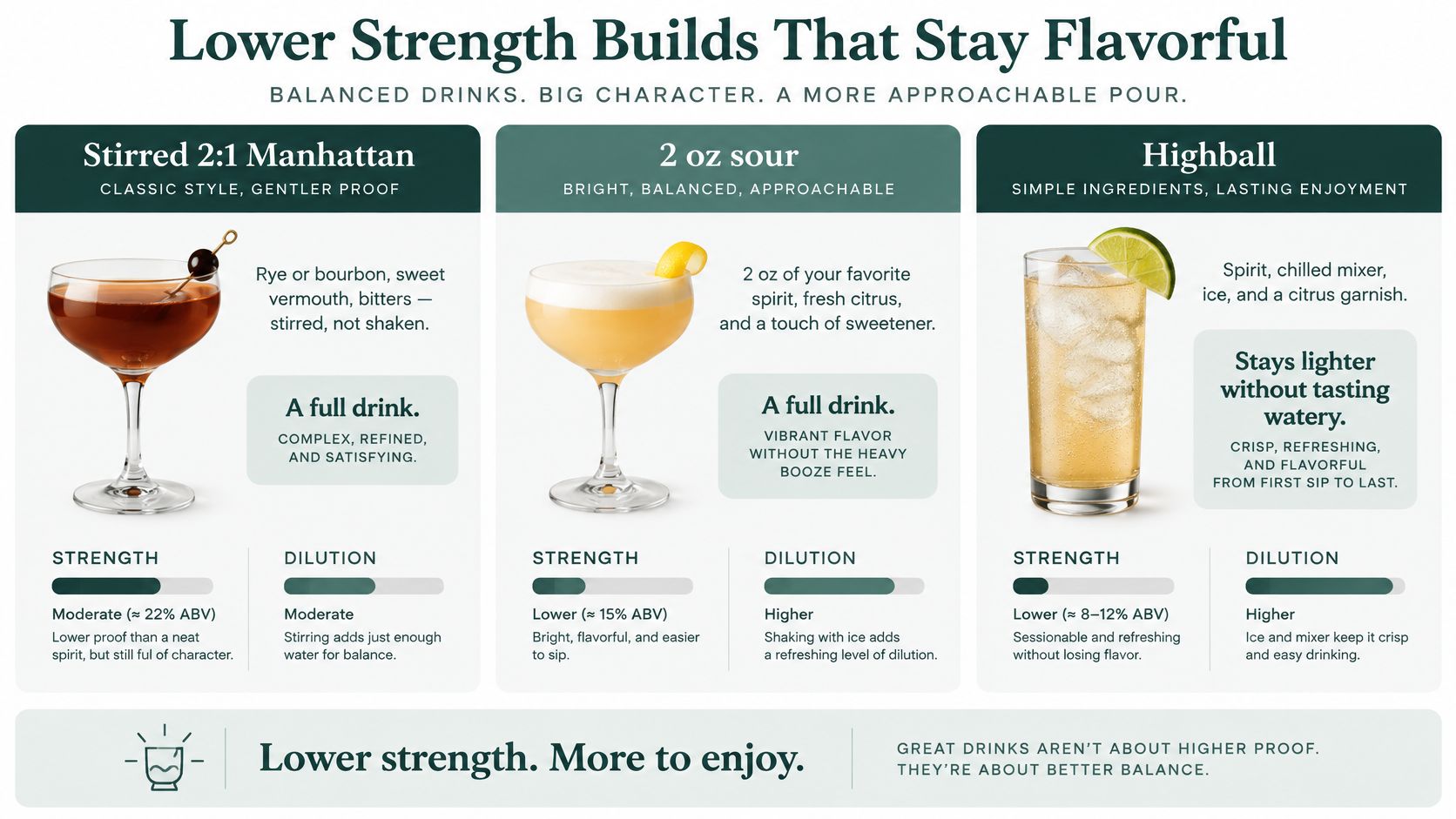
A lighter order is a routine request now. NIQ's moderation and mixed drinks analysis reports that 44% of consumers are drinking less alcohol than 12 months earlier, 64% want more low- or medium-strength options when going out, that figure reaches 73% among 18 to 34-year-olds, and 72% of spirits drinkers feel confident ordering a no- or low-alcohol alternative. Treat a lighter build as a standard row on the card rather than something you improvise mid-service.
Split the Base, Keep the Acid
To reduce alcohol without shrinking the drink, split the base. Use 1 oz whiskey and 1 oz chilled black tea or a bitter aperitivo in the spirit slot, then hold citrus and syrup close to the sour row so acid still carries the drink. Tea brings tannin and body that plain water doesn't, and a method like the Marie Antoinette iced tea recipe gives you a chilled, flavored base brewed before guests arrive. A bitter aperitivo works the slot from the other direction, trading part of the spirit for bitterness and aroma at full volume. Cutting the spirit and adding nothing leaves a hole. Replacing half of it with something structured fills it.
Zero-Proof Builds With Structure
Don't shake a non-alcoholic spirit with extra ice and hope. Build short and deliberate, with citrus, a measured syrup or preserve, saline or brine for savor, and soda or chilled tea for length. Bitters contain alcohol, so add them only if the guest asks for them. Serve the result in the same glassware family as everyone else's drink, with the same garnish care. A zero-proof round in a water glass reads as an afterthought.
When the spirit portion drops, flavor has to come from somewhere. Brine, citrus peel, preserves, and shrubs supply salt, acid, and aroma, which are exactly what a reduced base loses. Sugar alone can't do that work. Reaching for syrup first gives a sweet drink that still tastes empty, while a bar spoon of brine or a wide strip of peel gets closer to what the missing spirit contributed.
Keep one distinction sharp on the card. Less alcohol is not the same decision as a smaller pour. A half-size Manhattan is a smaller full drink. A split-base sour is a full-size lighter one. Guests asking for the second rarely want the first.
Set Out the Bar and Know When to Stop
Decide the menu before anyone arrives and stop editing it once the bar is set. Pick one family from the ratio card, one batched bottle, and one lower-strength path such as a highball, spritz, or zero-proof build. Every guest then has something they can order without a negotiation, and you aren't inventing drinks while people wait in your kitchen. If you need a frame for the spread around the drinks, the guidance on how to build an elegant aperitivo pairs well with a short card like this one.
- Set out tools first: Jigger, mixing glass, strainer, a clean scoop or tongs, and cut garnishes, with each drink's garnish written on a card beside its glass.
- Stage bottles in pour order: Spirit, modifier, citrus, syrup, then bubbles at the back, cold. Keep a spare bottle of the main spirit for any batch above eight guests.
- Pour the measured spec every time: A heavy free pour makes the batch inconsistent and your sense of how much anyone has had unreliable.
- Run water and food alongside: Put water on the table, serve food through the evening, check that anyone being served alcohol is of legal drinking age, and read labels for allergies before opening a mixer or garnish.
Stop pouring when a guest has had enough, and offer that guest water or a low-alcohol build without comment or ceremony. The card supports measured, moderate pours. It can't replace local law or your judgment as host, and a guest's comfort outranks finishing a batch you made too large. I'd rather pour the last of a batch down the sink the next morning than push one more round at midnight.
Build your short card, then stock only what it calls for. At Lello.Store you'll find cocktail garnishes, dehydrated citrus, maraschino cherries, dirty martini brine, preserves, and selected bar tools from small makers, chosen to improve the ritual rather than complicate it. Visit us to pick the garnish and pantry pieces your ten specs need, and leave the rest of the bar uncluttered.